Carlsbad Google Ads Agency : Professional PPC Management Services for California Businesses
In the competitive landscape of San Diego County, businesses seeking to maximize their online visibility and drive qualified leads increasingly turn to specialized digital marketing expertise. A Carlsbad Google Ads agency provides the strategic advantage needed to navigate the complexities of paid search marketing while optimizing advertising budgets for measurable results. As search engine advertising continues to evolve with sophisticated algorithms and targeting capabilities, partnering with experienced professionals has become essential for businesses aiming to achieve superior ROI through pay-per-click campaigns.
TL;DR Summary
Carlsbad Google Ads agencies offer comprehensive PPC management services including campaign strategy, keyword research, ad copy optimization, and conversion tracking. These specialized digital marketing firms leverage Premier Google Partner certifications and advanced tools like Google Analytics and Google Tag Manager to deliver measurable ROI for local businesses, e-commerce companies, and lead generation campaigns throughout California.
Google Ads Management Services Transform Digital Marketing Outcomes

Professional Google Ads management services encompass a comprehensive suite of capabilities designed to maximize advertising performance across multiple platforms and networks. Specialized PPC agencies in Carlsbad understand the nuanced requirements of businesses operating in California’s competitive markets, from local service providers to sophisticated e-commerce operations. These agencies implement data-driven strategies that align advertising expenditures with specific business objectives, whether focused on immediate conversions, brand awareness, or long-term customer acquisition.
The foundation of effective paid search marketing begins with thorough campaign strategy development. Expert PPC management companies conduct extensive market analysis, competitive research, and audience profiling to establish campaign parameters that align with client goals. This strategic framework guides all subsequent optimization decisions, from bid management tactics to ad extension implementation, ensuring coherent execution across Search Network, Display Network, Shopping Ads, and YouTube Ads platforms.
What Services Does a Certified Google Ads Agency Provide?
A professional Google Ads agency in Carlsbad CA delivers integrated services spanning the entire paid advertising lifecycle:
- Keyword Research and Selection: Identification of high-intent search terms aligned with business offerings and budget parameters
- Campaign Structure Development: Organization of account architecture to maximize Quality Score and Ad Rank performance
- Ad Copy Creation and Testing: Development of compelling advertising messages with continuous A/B testing protocols
- Landing Pages Optimization: Design and refinement of conversion-focused destination pages that reduce bounce rates
- Conversion Tracking Implementation: Setup of Google Analytics, Google Tag Manager, and conversion tracking systems
- Bid Management and Budget Allocation: Strategic adjustment of bidding strategies to optimize Cost Per Click and impression share
- Performance Analysis and Reporting: Regular assessment of campaign metrics with actionable insights and recommendations
Premier Google Partner Certification Validates PPC Agency Expertise
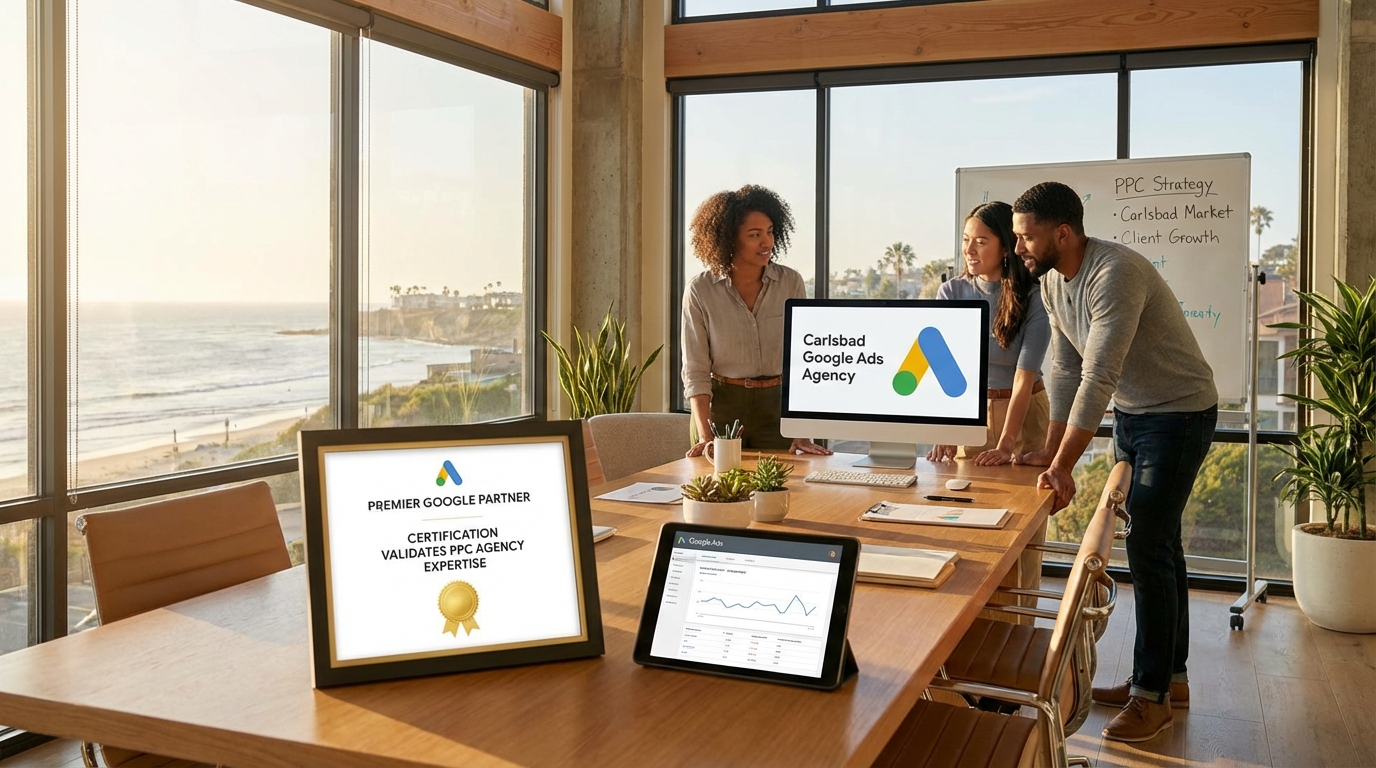
The Premier Google Partner designation represents the highest tier of recognition within Google’s partner program, signifying demonstrated expertise in AdWords management and consistent delivery of client results. Agencies holding this certification have met rigorous performance requirements including minimum advertising spend thresholds, client retention metrics, and individual certification of team members across multiple Google Ads specializations. For businesses in Carlsbad and throughout San Diego County, partnering with a Premier Google Partner provides assurance of working with a tested and verified digital advertising agency.
Certified Google Ads agencies maintain access to advanced platform features, beta testing opportunities, and direct support channels unavailable to standard advertisers. This privileged access translates into competitive advantages for clients, enabling implementation of cutting-edge advertising technologies and strategies before widespread availability. Additionally, Premier Partners receive ongoing training on platform updates, algorithm changes, and optimization techniques, ensuring their PPC services reflect current best practices rather than outdated methodologies.
How Does Google Partner Status Benefit Carlsbad Businesses?
Businesses working with a Google Ads partner agency gain multiple advantages beyond basic campaign management. These agencies have demonstrated proficiency across specialized areas including Shopping Ads for e-commerce operations, YouTube advertising for video marketing initiatives, and remarketing campaigns for audience re-engagement. The certification process requires passing comprehensive examinations covering Search Network optimization, Display Network strategies, and conversion optimization services, ensuring well-rounded expertise across all Google advertising platforms.
| Partner Level | Requirements | Client Benefits |
|---|---|---|
| Google Partner | $10,000+ spend in 90 days, 1 certified user | Basic platform support, partner badge |
| Premier Google Partner | $20,000+ spend in 90 days, multiple certifications, performance metrics | Priority support, beta access, advanced training, exclusive events |
Search Engine Marketing Strategy Integrates Multiple Campaign Types

Sophisticated search engine marketing approaches leverage the full spectrum of Google Ads campaign types to create comprehensive digital marketing ecosystems. A results-driven Google Ads agency Carlsbad develops integrated strategies that combine Search Network campaigns for high-intent queries with Display Network placements for awareness building, Shopping Ads for product visibility, and YouTube Ads for video engagement. This multi-channel approach ensures businesses maintain presence across the entire customer journey, from initial awareness through final conversion.
Campaign structure significantly impacts both performance metrics and optimization efficiency. Expert PPC advertising services organize accounts using logical hierarchies that separate brand terms from non-brand keywords, distinguish between product categories, and segment audiences based on intent signals. This architectural approach facilitates precise bid management, enables granular performance analysis, and supports efficient negative keywords implementation to eliminate wasteful spending on irrelevant queries.
Why Is Campaign Structure Important for ROI Performance?
Proper campaign organization directly influences Quality Score, which Google uses to determine Ad Rank and Cost Per Click. Well-structured campaigns achieve higher relevance scores by tightly aligning keyword groups with ad copy messaging and landing pages destinations. This relevance improves click-through rate, reduces advertising costs, and increases impression share within target auctions. Professional advertising campaign management continuously refines structural elements to maintain optimal performance as businesses evolve and market conditions change.
Conversion Rate Optimization Maximizes Advertising Investment Returns
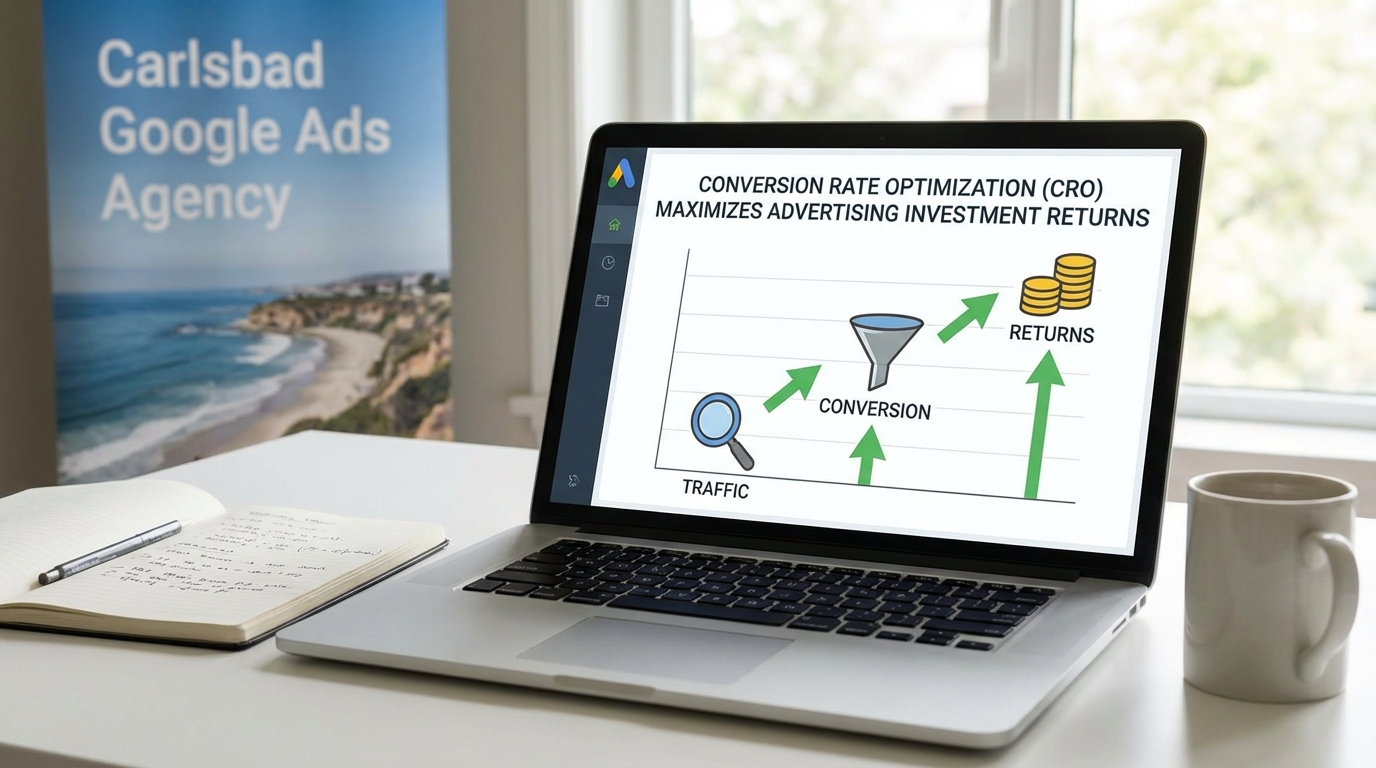
Conversion rate optimization represents the critical link between advertising traffic and business outcomes, transforming clicks into customers through systematic testing and refinement. A data-driven Google Ads agency Carlsbad focuses not merely on traffic generation but on conversion efficiency, recognizing that doubling conversion rates produces equivalent results to doubling advertising budgets. This emphasis on conversion optimization services encompasses landing page design, form optimization, call-to-action testing, and user experience enhancement across desktop and mobile devices.
Professional PPC management company methodologies employ rigorous A/B testing protocols to identify high-performing variations across ad copy, extensions, and destination pages. These controlled experiments isolate individual variables to determine causal relationships between changes and conversion performance, avoiding the unreliable conclusions of simultaneous multi-variable modifications. Statistical significance testing ensures that optimization decisions reflect genuine performance differences rather than random variation, protecting against premature conclusions that could harm campaign effectiveness.
What Metrics Indicate Successful Campaign Performance?
Comprehensive performance evaluation extends beyond vanity metrics to encompass business-relevant indicators that directly correlate with revenue and profitability objectives:
- Return on Advertising Spend (ROAS): Revenue generated per dollar of advertising expenditure
- Cost Per Acquisition (CPA): Total advertising cost divided by number of conversions
- Conversion Rate: Percentage of clicks resulting in desired actions
- Quality Score: Google’s assessment of ad relevance, landing page experience, and expected click-through rate
- Impression Share: Percentage of available impressions captured within target auctions
- Customer Lifetime Value (CLV): Total revenue expected from customer relationships initiated through campaigns
Local Business Marketing Requires Specialized Carlsbad Market Knowledge

Businesses serving Carlsbad and surrounding San Diego County communities benefit from PPC agency expertise grounded in local market dynamics, competitive landscapes, and regional consumer behaviors. A local Google Ads agency in Carlsbad understands geographic targeting nuances, seasonal demand patterns specific to California markets, and competitive bidding dynamics within regional auctions. This localized knowledge informs strategic decisions including bid adjustments for high-value geographic areas, ad scheduling aligned with local customer activity patterns, and messaging that resonates with regional audiences.
Small business operations face unique challenges in paid search marketing, including limited budgets that demand exceptional efficiency and local competition from established enterprises with substantial advertising resources. An experienced Carlsbad Google Ads experts team develops strategies specifically calibrated for small business constraints, focusing on high-intent keywords with manageable competition, leveraging ad extensions to maximize visibility without additional costs, and implementing conversion tracking systems that provide actionable insights despite limited transaction volumes.
How Do E-commerce Businesses Benefit from Specialized PPC Services?
E-commerce operations require distinct approaches centered on Shopping Ads optimization, product feed management, and dynamic remarketing campaigns. Professional e-commerce Google Ads management addresses the complexities of large product inventories through strategic feed optimization, category-specific bidding strategies, and automated rules that maintain efficiency at scale. Integration with analytics platforms enables sophisticated attribution modeling that accurately credits advertising touchpoints within multi-session purchase paths, providing realistic assessment of campaign contribution to overall revenue generation.
| Business Type | Primary Campaign Focus | Key Performance Indicators |
|---|---|---|
| Local Service Business | Search Network, local extensions, call tracking | Cost per lead, conversion rate, call volume |
| E-commerce Store | Shopping Ads, remarketing, Display Network | ROAS, cost per sale, cart abandonment recovery |
| B2B Lead Generation | Search Network, LinkedIn integration, long-tail keywords | Cost per qualified lead, lead-to-customer rate, CLV |
| Multi-location Franchise | Location extensions, geo-targeting, brand protection | Impression share, location-specific conversions, brand CTR |
Transparent Reporting and Performance Communication Build Client Trust
A transparent Google Ads agency in Carlsbad prioritizes clear communication through comprehensive reporting systems that provide clients with complete visibility into campaign performance, expenditure allocation, and optimization activities. Professional agencies eschew obscure metrics in favor of business-relevant indicators that directly connect advertising activities to revenue outcomes. Regular reporting cadences, supported by detailed analytics dashboards, enable clients to understand precisely how their advertising investments generate returns and where opportunities for improvement exist.
Performance marketing success depends on alignment between agency activities and client objectives, requiring ongoing collaboration rather than passive campaign management. Top-rated PPC agencies establish regular consultation schedules to review performance trends, discuss market developments, evaluate competitive dynamics, and adjust strategies based on evolving business priorities. This consultative approach ensures campaigns remain aligned with current objectives rather than operating according to outdated strategic frameworks established during initial setup.
Frequently Asked Questions
What is the typical cost of hiring a Google Ads agency in Carlsbad?
Google Ads agency pricing in Carlsbad typically follows either percentage-of-spend models (generally 10-20% of monthly advertising budget) or flat-fee arrangements ranging from $1,000 to $5,000+ monthly depending on account complexity, campaign scope, and service level. Many agencies require minimum commitments of $2,000-3,000 in monthly advertising spend to ensure sufficient data for effective optimization. Initial setup fees may apply for new account creation, conversion tracking implementation, and strategic planning.
How long does it take to see results from Google Ads campaigns?
Initial campaign results typically appear within the first week of launch, with traffic and conversion data beginning to accumulate immediately. However, meaningful optimization and performance improvement generally require 60-90 days as agencies gather sufficient statistical data to identify patterns, test variations, and refine targeting parameters. Quality Score improvements may take several weeks as Google’s algorithms assess campaign relevance and landing page quality. Businesses should expect continuous improvement over 3-6 months as comprehensive optimization strategies mature.
What makes a Carlsbad Google Ads agency better than self-managing campaigns?
Professional Google Ads agencies provide specialized expertise developed across hundreds of campaigns and diverse industries, enabling them to avoid common pitfalls and implement proven optimization strategies immediately. Agencies maintain current knowledge of platform updates, algorithm changes, and emerging best practices through continuous training and Premier Google Partner programs. Additionally, agencies utilize sophisticated bid management tools, automated optimization technologies, and comprehensive analytics platforms that represent significant investments beyond most individual business capabilities.
Do Google Ads agencies in Carlsbad work with businesses outside San Diego County?
Most Carlsbad Google Ads agencies serve clients throughout California and nationwide, as paid search management operates effectively as a remote service requiring no geographic proximity. While local market knowledge provides advantages for businesses serving Carlsbad and San Diego County specifically, digital marketing agencies regularly manage campaigns for clients across multiple states and countries. Video conferencing, screen sharing, and collaborative project management tools enable seamless communication regardless of physical location.
What information does a business need to provide when starting with a Google Ads agency?
Agencies typically require access to existing Google Ads and Google Analytics accounts (if available), conversion goal definitions, target cost per acquisition or return on ad spend objectives, competitive information, unique selling propositions, and customer demographic data. Historical performance data from previous advertising efforts helps establish baseline metrics. Additionally, agencies need understanding of business seasonality, geographic service areas, budget parameters, and any specific constraints regarding messaging, targeting, or competitive positioning.
How do agencies measure and report on campaign success?
Professional agencies establish customized reporting frameworks aligned with specific business objectives, tracking metrics including conversion volume, cost per conversion, return on ad spend, Quality Score trends, impression share, click-through rates, and competitive performance indicators. Most agencies provide monthly comprehensive reports supplemented by real-time dashboard access through Google Analytics and Data Studio. Advanced reporting includes attribution analysis, customer journey mapping, and cohort performance tracking that connects advertising activities to long-term business outcomes and customer lifetime value.
How to Integrate Social Media into SEO Strategies
While social media marketing and SEO seem like two separate practices, when used together, they can enhance any organization’s digital marketing strategy.
To increase brand awareness and drive more quality traffic to their websites, marketers should invest in search engine optimization.
Marketing teams use SEO to increase a website’s visibility when people search for products or services. Most people use search engines to find what they need, and are more likely to buy from or engage with a brand that appears high on search engine ranking pages (SERPs). When done correctly, SEO can help marketing teams rank higher on SERPs and see increases in traffic and its quality.
Marketers have a large number of ways to work on the SEO of a website, including access to various channels and tools. However, to improve the chances of appearing on SERPs, marketing teams need a good content strategy in place.
Blog content, links to internal and external sources, optimized meta descriptions and social media can help improve SEO. Social media is critical to a brand’s content strategy, as it serves as a channel to share content, connect with an audience, build awareness and drive traffic to a website.
Explore how an organization can incorporate social media into its overall SEO strategy.
How does social media affect SEO?
Social media does not directly contribute to how SERPs rank content. However, sharing links on social media platforms increases brand exposure and influences SEO.
Social media can indirectly increase search visibility and organic search rankings through metrics and social signals. Metrics like shares, likes and comments help build trust, customer loyalty and brand awareness. In addition, these metrics indirectly increase online visibility and traffic, which search engines look for to evaluate a brand’s online reputation and influence SERP rankings.
Effective searching requires a marriage between content and context. Search engines see sites as reputable if they have an SEO strategy and traffic driven to them regularly from various sources, including social media platforms.
Social media can influence SEO in the following ways:
Why is social media important for SEO?
Even if social media indirectly affects SERP rankings, it can influence SEO because it can drive quality traffic to websites and content such as blogs and campaign-focused pages. When a brand creates quality content that connects with and brings value to its target audience, consumers can become brand advocates. This audience engages with the content and can share it with their friends and followers. This cycle continues as followers find value in, engage with and share the content.
Quality content comes in various formats, including blog posts, videos, infographics, e-books, webinars, reviews and podcasts. These types of marketing collateral offer valuable information, encourage repeat visitors and can move leads down the marketing funnel.
If marketing teams use social media outlets to distribute content, they can amplify posts to wider audiences. Larger audiences can then increase visibility, improve traffic quality and generate backlinks to relevant websites, all of which indirectly affect SERPs.
SEO vs. social media
Social media management involves posting and optimizing content for social networks, while SEO involves making website content more searchable and therefore visible in SERPs for phrases and relevant industry questions.
Neither SEO nor social media is more important than the other. They support each other and each approach has benefits and drawbacks, but marketing teams can be more successful if they use both in an overall digital marketing strategy.
7 tips to incorporate social media into SEO
To effectively combine SEO and social media strategies, marketing teams can use these seven tips.
Social media helps people discover new brands, and SEO helps a brand generate more traffic from the target audience. Marketing teams using both can help their organizations increase traffic, awareness and authority from a variety of sources.
Dig Deeper on Enterprise search platforms and strategy
search engine
Top 4 SEO marketing challenges for 2023
Top 5 trends for the future of marketing
web crawler
How does social media play into an SEO strategy?
SEO is about optimizing your website so that it results in searches made by people looking for your product or service, and entices them to visit your website. Social media does the same thing – getting your name and content in front of people interested in your offer.
How do I incorporate social media into the SEO strategy? Encourage your social media followers to link to your website. Link-building is one of the most effective SEO strategies. Backlinks from relevant websites build your site’s authority. With greater site authority, search engines like Google see your website as more credible so it ranks higher on the SERP.
How does social media contribute to SEO?
Social media does not directly contribute to SEO ranking, but the links you share between social platforms increase brand exposure. They add up and influence search engine optimization in six directions: Extensive content distribution. Longer life of your posts.
How social media trends can influence your SEO?
Examples of search results influenced by social media trends If we collect a list of social media trends from the last few years and search for their related terms on Google Trends, we can find a recurring pattern â search results for related terms increase at the time of their social media trends going viral.
Does social media count in SEO?
Social media is not a ranking factor, so it won’t directly help your rankings. While there is no direct ranking correlation between the two, the benefits of social media merge into SEO. And if you’re trying to improve your SEO, it’s especially important for you to invest in social.
How do I combine social media and SEO?
How To Successfully Combine SEO And Social Media For Better Results
- Align Your Content and Social Media Teams. …
- Share Your SEO Content on Social Media. …
- Make sure the SEO Content is Optimized for Sharing. …
- Cross-Promote on both channels. …
- Make it Easy for People to Share Your Posts. …
- Take advantage of Two-Way Retargeting.
.
What is Social Media Optimization in SEO?
Social Media Optimization (SMO) encourages businesses to assess, monitor, and change their content to conform to social media best practices. All types of businesses prefer to build their presence in social media by posting content on platforms such as Facebook, Instagram, Twitter, etc.
Why is social media optimization important for SEO? Social media does not directly contribute to SEO ranking, but the links you share between social platforms increase brand exposure. They add up and influence search engine optimization in six directions: Extensive content distribution. Longer life of your posts.
Is social media more important than SEO?
Simply put, SEO is focused on optimizing your website for search engines. This optimization is important because search engines are more efficient at generating higher traffic to your website than all social media sites combined.
Which is better social media marketing or SEO? SEO requires constant effort, but often draws more conversions than social media marketing. SEO is an excellent method to generate visitors, and once a page is live on your site, it has the opportunity to rank highly for the keywords it targets.
What is the relationship between SEO and social media?
SEO is the process of improving a company’s website in order to boost search engine rankings. And social media, well that’s the act of creating posts with copy and maybe even images on various social sharing platforms like Twitter, LinkedIn, Facebook, etc.
Is social media and SEO the same?
The SEO strategy considers which keywords provide the most value, along with other tools such as formatting and link building. Social media marketing is more about building relationships online and engaging with your buyers, creating brand awareness along the way.
What does SEO stand for in social media?
SEO stands for âsearch engine optimization.â In simple terms, it means the process of improving your site to increase its visibility when people search for products or services related to your business in Google, Bing, and engines other search engines.
What is the relationship between SEO SEM and social media marketing?
SEM is search engine marketing. It is a combination of SEO and PPC advertising. These are the ads at the top of your Google search. Social Media Marketing (SMM) is social platform marketing including Facebook, Twitter, and Instagram unpaid social media marketing and paid advertisements.
Is SEO still relevant in 2022?
The fact that SEO works perfectly even in 2022 as a method to deliver improved business results for business websites and their owners, together with the need for continuous research on what works, makes it still relevant as a method of ‘ digital marketing, but more and more. as a valuable and rewarding service…
Will SEO exist in 5 years?
SEO will not be eliminated in the next five years because social media and search engines will probably merge. Facebook has already started doing this: an average of more than 1.5 billion searches per day. Twitter did the same; joined in partnership with Google.
Is SEO worth it in 2022?
Yes, SEO is worth it in 2022, in the future, in the past, and always. As long as websites and search engines have existed, SEO has been necessary. SEO 10 years from now will probably be very different from SEO today, but you always have to make sure that your website is sending search engines the right signals in order to be found.
What is the future of SEO in 2022?
By 2022, expect SEO ranking to be more competitive by providing high-quality content that is helpful to internet users. Content that only tries to fish for their audience by linking unnecessary sources will not be as effective as it is today.
Does social media Help Your SEO?
Social Interaction Data Can Help You Improve Your SEO Content. Social Media Helps Build Search Demand. Social Media Helps You Identify the Audience for Your SEO Content. Social Media is a Great Place to Conduct Keyword Research.
Google makes links less effective for SEO
Link building remains a major part of search engine optimization due to the fact that this is the type of thing that can end up making a website more worthy for web crawlers. Although this is the case, it seems that Google is going through a slightly different process when it comes to ranking a website on the SERP. It appears that Google will not provide the same number of links as it did in the past.
This comes from a comment made by Google’s John Mueller on a recent video where he claimed that Google’s search algorithm is being changed to make links less useful for SEO purposes. This is similar to what former Google employee Matt Cutts claimed in 2014, and with all that said and now out of the way it is important to note that his words have been useful since the bond has seen continued declines in value. since those days.
Google itself issued a statement two years ago confirming that links are not considered a major factor when determining position on the SERP. This means that your link building efforts will prove to be less useful in the future than it would otherwise be, and could shake the SEO industry to its core.
Many SEO experts have invested a lot in link building, and they may need to come up with new ideas and methods with all the factors considered and taken into account. Google often makes changes to improve the quality of its search results, and people who work in the industry usually need to keep up with these changes so they don’t get left behind.
It remains to be seen if these changes will be drastic or if they will be drastic, but everything that can be the pros of SEO must change things. It will be interesting to see what the results of these changes might look like.
Read next: What Are the Biggest Google Searches Every Year?
What is replacing SEO?
Search Engine Optimization (AEO) to Replace Search Engine Optimization (SEO)? Marketers and content creators are increasingly focusing on SEO optimization. Search engines are constantly updating their SEO algorithms and techniques to provide a better user experience.
Is SEO still relevant in 2022? The fact that SEO is working well even in 2022 as a means of delivering better business results for business websites and their owners, along with the need for continuous research on what works, makes it still relevant as a method digital marketing, but even more. as an important and rewarding service…
What is the future of SEO in 2022?
By 2022, expect that the SEO position will be more competitive with the creation of quality content that helps internet users. Content that only tries to capture their audience by including unnecessary sources will not be as effective as it is today.
Is SEO going to end?
No. SEO is not dead in 2022. SEO is still a very powerful digital marketing strategy. SEO will continue to change as Google updates its algorithm but that is to be expected.
How long will SEO last?
Most experts expect to see results in less than 2 months, but SEO can take up to 12 months to work. While each company’s SEO strategy is different, most businesses can expect to see significant results within 6 to 12 months.
Does SEO have a future?
SEO will only grow faster in the future. Just make sure to follow SEO best practices like creating helpful content, having a fast website, and following Google’s guidelines to get better rankings.
Will SEO exist in 10 years?
Speculations abound, but they don’t always provide accurate predictions of what’s to come. One thing is certain, however: SEO will be around for a long time. As long as search engines exist and internet users continue to use keywords and phrases to find what they are looking for, the search engine business will continue.
Will SEO be replaced by AI?
AI will completely change SEO as we know it. From optimization to link building, it will greatly impact every aspect of SEO. As artificial intelligence (AI) becomes more sophisticated, search engine optimization must adapt.
Can too many links hurt SEO?
However, this is the time to think carefully, because it is the quality of the links, not the quantity, that plays the most important role. Too many internal links can have a negative impact on a website’s ranking. Google’s John Mueller also says that high traffic on a website is good for SEO rankings.
Can you find many links on the website? While there is no hard limit to the number of hyperlinks on each page, consider limiting hyperlinks to what makes sense. If adding a link provides important context or navigational ability, add it – but if your page has too many unnecessary links, you may be creating a poor experience for users.
How many links is too many SEO?
“More than 100 internal links on a single page is excessive.” Google continued, “Google may stop following or de-follow all of these links” if a website has more than 100 internal links. say you will be â you will share the PageRank of this page over hundreds of linksâ by getting excessive internal links.
How many hyperlinks are too many?
One link per 500 words is a good rule of thumb While there is no official limit to the number of links you can place on any web page, use your best judgment. Ideally, you should only link to content that will provide the visitor with relevant information related to the content they are currently consuming.
How many links are good for SEO?
Many industry experts, however, advise against linking more than once to the same page. Based on what we found from our own research: We recommend 1-2 external links for every 500 words of content.
How many links is too many in an article?
Placing more than a hundred backlinks does not directly affect your site negatively if your page authority is high. But if you’re just starting a small business, doing so can do more harm than good. Just to be sure, just follow the guidelines that most SEO strategies recommend. No more than 150 links per page.
Are too many links bad for SEO?
The right number of internal links Add 10-20 per page for a 1,500-word blog is also a good number. There is no limit on the number of links on a page. As long as you are citing links that are valuable and relevant to the context, it is not bad for your site’s SEO ranking.
Do links affect SEO?
The answer is no. According to Mueller, âThere is nothing to prevent linking to sites like these.â Although linking to sites that are not secure affects SEO, the HTTPs protocol has been a popular position since 2014.
Are links good for SEO?
Links (both from other websites and links to your own website) are important for SEO because there is a direct correlation between the quality/quantity of your links and the amount of search traffic your site receives. For small businesses, more links = more search traffic = more customers.
Do internal links hurt SEO?
Internal links are important for SEO as they send a signal to Google about which pages are the most important for a particular website. They don’t send the same signal as external links, but they are still important. In addition, Google uses internal methods to understand the structure of the site.
How many links are good for SEO?
Many industry experts, however, advise against linking more than once to the same page. Based on what we found from our own research: We recommend 1-2 external links for every 500 words of content.
What are the aspects of hyperlink?
HTML code contains some or all of the five main characteristics of a link:
- link (“href” indicates URL)
- link title.
- title link.
- target link.
- link class or link id.
What exactly are the two parts of hyperlinks? A link has two basic parts: the address (URL) of the web page and the display text. For example, the address could be http://www.popsci.com, and the display text could be Popular Science Magazine.
What are the 3 types of hyperlinks?
Hyperlink text – Uses a word or phrase to take visitors to another page, file or document. Image hyperlink – Uses an image to take visitors to another page, file or document. Hyperlink symbol – Uses text or an image to take visitors to another part of the web page.
What are the most common hyperlinks?
Text links are one of the most common types of links on the web. Clickable text is used to go to a page or resource.
What is hyperlink and its types?
Hyperlink text: Uses a word or phrase to take visitors to another page, file or document. 2. Image hyperlink: Uses an image to take visitors to another page, file or document. 3. Bookmarks: Uses text or images to direct visitors to another part of the web page.
What are examples of hyperlinks?
Links can be presented in various forms, such as an image, icon, text, or any other type of visual element that, when clicked, redirects you to a specific url. For example, if you click HERE, you will land in my profile with a list of my other articles. This is the link.
What makes a link toxic?
What Are Toxic Backlinks? As you might expect, toxic links are those that harm your website’s ranking in the eyes of Google. Many of these types of links have their roots in black hat SEO tactics, ill-conceived attempts to game the search engine algorithm to get higher rankings.
What is a toxic score for a website? Toxicity score is how the Backlink Audit Tool determines which of your links are the most dangerous for your website. The toxicity score is based on a scale of 0 to 100, with 0 being good and 100 being very toxic.
What is a toxic link?
A âtoxicâ link is generally considered to be a link that has the potential to harm your website’s ability to rank. However, not all SEOs agree on how to define toxic links and whether their presence can actually harm your ranking.
What are bad links called?
A link that no longer points to its target, often called a broken or dead link (or sometimes an orphaned link), is a specific type of pointer. Link decay is a topic of study and research because of its importance to the internet’s ability to store information.
How do I remove a toxic link?
Understanding what makes a ‘poisonous’ backlink Use the tool to identify all the bad links pointing to your website. Contact the webmaster and request removal. Create and submit a ‘disavow’ file to Google to disavow these links.
How do you know if a link is toxic?
Toxic links usually show signs of poor quality or ranking control efforts such as: Coming from sites that are set up solely for the purpose of linking. It comes from pages and content that are not important. It comes from non-Google sites.
How do you know if a link is toxic?
Toxic links usually show signs of poor quality or ranking control efforts such as: Coming from sites that are set up solely for the purpose of linking. It comes from pages and content that are not important. It comes from non-Google sites.
How do I remove a toxic link?
Understanding what makes a ‘poisonous’ backlink Use the tool to identify all the bad links pointing to your website. Contact the webmaster and request removal. Create and submit a ‘disavow’ file to Google to disavow these links.
What kind of links harm your rankings?
Any link created or purchased with the intention of manipulating PageRank that directly affects the site’s ranking in the search results is called an invalid link. Low quality links are links from small web directories, low quality directories, small guest posts, or spam comments.
What are some of the risks of clicking on a bad link?
Clicking the wrong link can load malware-laden websites that will download malicious files in the background. Once the malware is on your computer, you can end up with a time bomb that can cause damage to your device, your network, or your finances.
What if I accidentally click a link on my phone? Scan your system for malware. If you have antivirus software on your device, run it to scan your system. Follow the prompts to remove all suspicious files found.
What are the risks of clicking on a suspicious link?
Malware can be installed on your device malicious software, such as spyware, ransomware or viruses can be installed without the user’s knowledge. These malicious files can infect your device and collect personal information of the cybercriminal.
Is it possible to get a virus from clicking a link?
Yes, you can get a virus just from visiting a website. These days, it is easy to be confident in our ability to avoid computer viruses. After all, many of us have been told that we must avoid files and programs that we do not recognize. If an email comes through that looks fishy, we don’t open it.
What if I accidentally clicked on a suspicious link?
Disconnect your device from the Internet. Disconnecting the network will help reduce the risk of spreading malware to other devices on the network. This will also prevent a malicious actor from accessing your device or sending private information from it.
What happens if you click on a bad link?
Clicking on a malicious link embedded in a phishing email can have serious consequences including data theft, account compromise and financial loss. One wrong click can cause serious reputational damage and significant downtime – or even permanent closure – for a business.
Can you get a virus from clicking on a bad link?
Yes, you can get a virus just from visiting a website. These days, it is easy to be confident in our ability to avoid computer viruses. After all, many of us have been told that we must avoid files and programs that we do not recognize. If an email comes through that looks fishy, we don’t open it.
Can you get scammed just by clicking a link?
No matter how cautious a person is in general, we all have a tendency to click on links. Often times, the intention behind these links is to catch unsuspecting people with scams. Scams use emails and texts that appear to come from someone you know, such as a friend, colleague, or company.
What if I accidentally clicked on a suspicious link on my phone?
If you suspect your device has been hacked after clicking on a link, the first thing you should do is disconnect your device from the internet and all other communications. This will prevent malware from spreading to compatible devices.
The SEO Career Path: What It May Look Like and How to Level Up
Search Engine Land » SEO » The SEO career path: What it looks like and how to level up
People outside the world of marketing rarely know what SEO is or what initialism even stands for.
In the industry, it is a familiar term for all formidable marketers. Much less is SEO – search engine optimization – actually understood.
First, it’s important to understand that, while SEO stands for search engine optimization, it’s also often used interchangeably to describe the people who do SEO (aka SEO professionals). An SEO – or search engine optimizer – does SEO. SEOs do SEO.
To avoid further confusion, we refer to the people who do SEO as SEO professionals.
SEO professionals are a special breed of marketers from many walks of life.
But there are some characteristics and experiences that many of us have in common that I will try to organize as some of the most useful and common professional qualities possessed by SEO professionals.
I will also cover what the career path to becoming one might look like.
How do you start an SEO career?
Historically, most SEO professionals did not plan on SEO as a career – at least until recently (starting in the late 1990s and early 2000s). That was because they couldn’t, really.
Early in their educational journey, a marketer or digital marketer very rarely – if ever – declared: “I want to optimize websites and follow the Google algorithm for brands to change the way people and businesses connect forever.”
The last part of that questionable statement was probably similar to something many marketing-in-training have declared.
But getting there through website and brand optimization to get organic visibility on a search engine was not likely the vehicle they had in mind at the time to achieve it.
It is also rare to meet several SEO professionals who have taken the same path to become one.
But there are certainly overlapping journeys, professions and experiences.
Some common past areas of expertise for SEO professionals that generally intersect include teaching, journalism, various mathematically focused professions and the obvious traditional marketing focuses.
But as the worldwide web has evolved as it has over the past 30 years, opportunities to help brands and people in new ways have emerged in the marketing realm. And some have become more specialized – and lucrative – than ever.
Organic search, paid media and social media are all suitable channels for successful marketing strategies. And they were indirectly or directly created (or adapted for use) for the growth, prominence and usefulness of websites.
Today, as a result, high school and college students can set their sights on a digital marketing gig specializing in SEO. This will continue to become more common as secondary education institutions evolve with the needs of the world, job demands and technology.
Receive the search marketer’s daily newsletter.
Possible SEO career routes
Like most careers, there are several directions an SEO professional can take.
It is probably most likely to start at an agency, and that is a wonderful place to start almost any career related to marketing (or design, account management, video production or sales).
There are typically a bunch of talented people with a wealth of knowledge and direction to share, so it’s like getting an education while getting paid.
You also get the chance to really find your niche in whatever facet of digital marketing you end up in, whether it’s SEO itself or a more specific component within SEO.
Your first few years in SEO will likely shape your long-term future, at least to some extent.
You can also strengthen and/or stand out by demonstrating strengths with the critical soft skills mentioned above and your ability to communicate effectively with internal and external stakeholders.
Agency life allows these skills to shine while also finding out if agency life is for you.
You must be able to constantly juggle multiple deliverables and multiple deadlines, often jumping between different projects on the same day and throughout the week.
The other direction you could go is directly in-house at a company.
But if you’re looking to boost your SEO skills as a beginner, that could prove difficult without a good SEO company to guide you and teach you many of the basics to be successful.
Larger companies would be more likely to have more qualified SEO professionals employed in one team at a time. Getting into such an opportunity is difficult for someone with little to no experience.
Another potential direction an SEO career could go is strictly freelance or as an independent consultant.
This was probably the most common way to get into SEO back when Google and the wonders of search were still in their adolescent years. Today it has become more difficult because the search has become more complex and the choices for providers have increased significantly in the world.
These are three different potential career paths an SEO could follow. They usually overlap at some or several points based on what the SEO wants to do, which steers them in that direction.
All three majors also offer the ability to work in different environments (ie, working in a traditional office environment, working from home, or a hybrid set-up).
SEO, like most digital marketing careers, offers flexibility when it comes to the place of work and also the time of day that you do this work.
SEO job levels and salary ranges
The SEO career path will likely move from entry-level to experienced roles. And when it comes to salary, like all things in SEO, it depends.
Many variables affect compensation, including your location, work environment, whether you work in-house or agency-side, and experience level, among others. (We’ve done our best to put a general range at these levels.)
Entry-level
Salary range: $49K – $72K per year
So many jobs start with a basic, lower-level position, but there’s also a lot like getting paid to continue practical training in your specific field.
Landing the first position on the entryway is usually the harder task. When you take over the post, you want to learn as much as you can as quickly as you can. Make sure you absorb everything you can.
Unfortunately, (or fortunately, for the lucky ones) having a great or terrible leader to guide and train you at this critical stage of your early career could make or break you. Make the best of it.
Junior SEO (SEO analyst, SEO specialist, etc.)
Salary range: $62K – $101K per year
Once you’ve got the basics down and run the day-to-day with limited help, your entry-level position should move up to something a little more senior, like an SEO analyst or specialist (it’s not actually a senior position, though).
These junior SEO positions usually do a lot of the data pulling and living-in-Excel that builds a solid, effective SEO. These are long-term tasks that build SEO professionals at their core, and they cannot be replaced or shortened.
You will likely work closely with an SEO Manager and their Senior SEO Leader to:
SEO strategist
Salary range: $69K – $110K per year
After time as a junior SEO, be ready for a little more reasonableness, a little more account ownership, and even some chances to train other new employees (regardless of experience levels).
Some of the “training” you do will probably not be highly complicated SEO tasks, but rather internal tasks related to the SEO process in the company. This could include:
SEO manager
Salary range: $80K – $120K per year
SEO managers are typically the first administratively oriented SEO roles within agencies. New SEO managers usually supervise one or two SEO professionals to get a feel for their style, effectiveness, strengths and weaknesses.
These managers also usually manage multiple client accounts and their own workloads.
This period in an SEO career can also allow people to see what their next role will look like by identifying things they do and don’t like.
Senior manager (head of SEO, director of SEO, etc.)
Salary range: $109K – $192K per year
After successful posts at the top as an SEO manager, a senior version of that usually follows.
As a senior manager, who could also be the head of SEO or even a director, you take on significantly more responsibility, not only as an individual, but as a representative of the agency or company you work for, as well as the clients you work with and represent. as a leader of their organic initiatives.
Vice president
Salary range: $124K – $224K per year
VPs tend to hold some of the highest-ranking, SEO-focused positions at the top.
While VPs of SEO/Organic are still highly integrated with SEO efforts and usually oversee entire teams or more in that area, they are still very much responsible for:
C-suite (CMO, CEO, etc.)
Salary range: $192K – $550K per year
This is probably the ultimate goal of many digital marketers, not just SEO professionals.
Some start their own companies, others join companies as veteran thought leaders and try to take those companies to the next level, and others are just so right for the job, there’s nowhere else they really belong.
Good, effective marketers will always be in demand, and the best ones will lead the best companies in their organic growth initiatives.
When an SEO makes it to the C-suite, they are likely to:
Of course, these are not definitive paths through the SEO ranks.
Every company and agency has its own way of doing things. Sometimes it looks like this, other times it looks slightly different, and sometimes it looks extremely different.
It’s important to stay on the path that works for you and take the necessary steps to get to where you want to be.
Best ways to advance your SEO career
It is necessary to understand that SEO education never ends. Staying ahead of the game is a shining factor that separates decent from great SEO professionals.
As such, educating yourself about the many facets of SEO and digital marketing should be a top priority for someone trying to get their feet wet in the profession for the first time.
Stay on top of changes and developments in the industry through online forums and SEO-related news. Keep a constant eye on Google’s Search Blog.
From there, once a gig is landed, the most important aspect of building an SEO career comes to you every day: real-life SEO experience with clients, internal stakeholders, vendors, and/or agency partners, among others.
You will also continue your education afterwards. Almost every day you read blogs and news in the ever-changing industry.
You will attend state-of-the-art conferences and virtual seminars. Eventually, you can also speak at these events and guide SEO professionals from around the world.
SEO professionals love to help each other as much as they love to learn from each other. It’s one of the best parts of being an SEO and it’s why you’re hard pressed to find a great SEO who doesn’t like another great SEO. We are in this together and there is a lot going on!
The daily trials and tribulations in the field are the best way to find your way as an SEO.
Most importantly, you should know if SEO is right for you early and often. I know I did, and still do a lot.
Opinions expressed in this article are those of the guest author and not necessarily Search Engine Land. Staff authors are listed here.
Sam Hollingsworth is a native (upstate) New Yorker who currently resides in Saratoga Springs, New York, and helps lead SEO efforts for Moving Traffic Media as the Director of SEO. With a background in general SEO – specializing in local SEO, e-commerce SEO, and international SEO – as well as content strategy, social media and customer services, when Sam isn’t spending time at the digital agency, he’s probably enjoying one of the many historical thoroughbreds America’s racing track that takes in the great outdoors (Adirondack Mountains, Great Sacandaga Lake, and more), and hangs out with his family on all the adventures they find.
Is SEO a long term job?
There are different search engines and all the most popular search engines are always changing their algorithms to show results. So SEO is definitely not a bad idea in the long run.
Will SEO exist in 5 years? SEO will not be eliminated in the next five years, as social media and search engines will more than likely merge. Facebook has already started doing this: they average over 1.5 billion searches every day. Twitter did the same; they are in collaboration with Google.
Is SEO job stressful?
Any job can be stressful based on the type of performance required by your company. It’s the same with SEO-related jobs. However, it is not as stressful as IT or other programming jobs.
Is working in SEO a good career?
‘ Yes. SEO is a good career option as it is among the most sought after careers in the digital marketing field. There are various organizations around the world, hiring SEO professionals to generate better content and thereby produce more business leads.
Is a career in SEO worth it?
SEO is a promising career in 2022 as it gives you access to various opportunities. You can work in-house, take on clients, and even start and grow your own websites. Plus, the three most popular websites, Google.com, YouTube.com, and Amazon.com, are the biggest search engines.
Does SEO pay well?
SEO Specialist Salary by Years of Experience The average salary for an SEO specialist with 7 years of experience is $75,067. The average salary for
Is SEO a good career for the future?
The simple answer is yes, SEO is a good career. SEO professionals can earn good money, achieve a comfortable work/life balance, find a position in the industry that suits their natural abilities, and challenge themselves creatively.
Is SEO a good career for the future?
The simple answer is yes, SEO is a good career. SEO professionals can earn good money, achieve a comfortable work/life balance, find a position in the industry that suits their natural abilities, and challenge themselves creatively.
Is SEO a long term career?
And also, the domain in which you work changes your task and most of the time you learn new ways of SEO. There are different search engines and all the most popular search engines are always changing their algorithms to show results. So SEO is definitely not a bad idea in the long run.
Is a career in SEO worth it?
SEO is a promising career in 2022 as it gives you access to various opportunities. You can work in-house, take on clients, and even start and grow your own websites. Plus, the three most popular websites, Google.com, YouTube.com, and Amazon.com, are the biggest search engines.
Is learning SEO worth it in 2022?
There is no doubt that SEO investment is an indispensable part of your online business. Not only does SEO get you a high ranking on Google, quality traffic, high visibility of your website, but also provides you with the versatile strategy that helps you advertise, sell and also boost your brand performance.
What does an SEO employee do?
A search engine optimization or SEO specialist tests, analyzes and changes a website so that it is optimized for search engines, and the website then ranks higher in the search results on major search engines such as Google and Bing.
Is SEO job stressful? Any job can be stressful based on the type of performance required by your company. It’s the same with SEO-related jobs. However, it is not as stressful as IT or other programming jobs.
What does a SEO Specialist do daily?
A search engine optimization (SEO) specialist improves website rankings on major search engines, such as Google, Yahoo! and Bing. The specialist guarantees on-page optimization to produce relevant search results and a positive user experience, growing site traffic, lead volume and brand awareness.
Is being an SEO specialist Hard?
SEO is not that hard to learn. All you have to do is be willing to allocate the necessary time and effort to learn the various SEO concepts. If you’re just getting started with SEO and wondering what it takes to go from beginner to expert, then this post is for you.
Is SEO a stressful job?
You have to deal with big and small clients, calm and totally stressed, those who believe in SEO and those who think you are just trying to get more money for useless things!
Is SEO a full time job?
SEO involves many areas from content writing to technical optimizations and everything in between. It’s a full-time gig, not one for just the weekend or as an employee’s third responsibility.
Is working in SEO a good career?
‘ Yes. SEO is a good career option as it is among the most sought after careers in the digital marketing field. There are various organizations around the world, hiring SEO professionals to generate better content and thereby produce more business leads.
Does SEO pay well?
SEO Specialist Salary by Years of Experience The average salary for an SEO specialist with 7 years of experience is $75,067. The average salary for
Is a career in SEO worth it?
SEO is a promising career in 2022 as it gives you access to various opportunities. You can work in-house, take on clients, and even start and grow your own websites. Plus, the three most popular websites, Google.com, YouTube.com, and Amazon.com, are the biggest search engines.
Is SEO a good career for the future?
The simple answer is yes, SEO is a good career. SEO professionals can earn good money, achieve a comfortable work/life balance, find a position in the industry that suits their natural abilities, and challenge themselves creatively.
What are SEO duties?
SEO specialist roles and responsibilities
- Develop optimization strategies that increase company website search engine results ranking.
- Conduct tests, collect and analyze data and results, identify trends and insights to achieve maximum ROI.
What does an SEO specialist do every day? Every day, SEO experts review the website’s performance and keyword position analysis to see how things are going. The results may change from day to day with Google algorithms, updates and user dynamics. So, it is crucial to do daily checks to see how each page of the website you are promoting is working.
What are SEO skills?
The job of a Search Engine Optimization specialist with SEO skills is to analyze and review websites and optimize them in a way that they are picked up by the search engines. The SEO specialist aims to ensure increased traffic to a website by developing content with appropriate keywords and phrases.
Why SEO skills are important?
SEO is made up of different elements, and knowing what they are and how they work is the key to understanding why SEO is so important. In short, SEO is crucial because it makes your website more visible, and that means more traffic and more opportunities to convert prospects into customers.
Is Google SEO a skill?
While it may not sound as obvious as technical skills like coding languages or web design, search engine optimization is a crucial skill for almost any web-related role.
Is SEO a hard skill?
At the top of the list of important hard skills is search engine optimization. Data from the study is based on a LinkedIn survey conducted by Microsoft with 600 global senior marketer participants.
Is SEO a full time job?
SEO involves many areas from content writing to technical optimizations and everything in between. It’s a full-time gig, not one for just the weekend or as an employee’s third responsibility.
Is working in SEO a good career? ‘ Yes. SEO is a good career option as it is among the most sought after careers in the digital marketing field. There are various organizations around the world, hiring SEO professionals to generate better content and thereby produce more business leads.
Is SEO a long term career?
And also, the domain in which you work changes your task and most of the time you learn new ways of SEO. There are different search engines and all the most popular search engines are always changing their algorithms to show results. So SEO is definitely not a bad idea in the long run.
Can I do SEO as a part time job?
Remote SEO Specialist Job Types: Full Time, Part Time. This is a part-time employee position, not a contractor. Our team consists of talented and creative people. Edit and update website pages.
Can SEO be a side job?
If you’re looking to learn a new skill to make money next year as a side hustle or full-time job, SEO is probably one of your best options.
Is SEO job difficult?
SEO is not that hard to learn, but it can be confusing and overwhelming to get started. Learning SEO means learning about a long list of individual digital marketing strategies, which can feel a bit like adding new weapons to your arsenal as you learn how to exercise them.
Is SEO good for freelancing?
If you want to become an SEO freelancer, you are in good company. This is a popular choice for freelancers and an in-demand field. Every place with a website wants its websites to show up in the top search results. It can make or break their business or revenue stream.
Is SEO an in demand skill?
However, it is worth noting that the demand for SEO skills is through the roof, as search engine optimization is increasingly important for any job posting in communications, digital marketing or social media marketing. Here are some common SEO job titles: Search engine optimization (SEO) specialist.
What skills will marketers need in the future? Executives say that skill in content marketing, strategy, and data/analysis will be the most important skills for marketers in the future, according to recent research from Drift. The report is based on data from a survey of more than 100 marketing leaders across 25 industries.
What marketing skills are most in-demand?
Globally, digital marketing expertise is the number one skill listed by marketers on their LinkedIn profiles, followed by social media marketing and search engine optimization. Marketing strategy comes in fourth, followed by knowledge of Adobe Photoshop, email marketing and content.
Is marketing still in-demand?
Is there a demand for digital marketers? With 860,000 jobs, Digital Marketing Specialist is among the top 10 most in-demand jobs, according to LinkedIn. You must have experience in digital marketing areas, such as social media, content strategy, SEO, and more.
What type of marketing is most in-demand?
Today, digital marketing is one of the most in-demand fields out there. And in this article we will tell you everything you need to know about it and how to get the job.
What skills will marketers need in 2025?
Machine learning, sophisticated analytics, and neuromarketing are considered to be the most important skills in the marketing department in 2025, and the tools that enable these will sit at the top of the shopping list.
How do you think marketing will be different in five 5 years in 2025?
By 2025, marketers will be slicing and dicing metadata for actionable insights and highly specific marketing. Brands will use complex combinations of personal data, location data and environmental data to target their customers with the right message at the right time on the right device.
What is the future of marketing in 2025?
The future marketing trends of 2025 will focus on interactive, engaging communication with the consumer more than ever before, making advertising easier than ever before.
Lyayo Designs is launching search engine optimization services all over Nepal
Search Engine Optimization In Nepal
Lyayo Designs, a leading provider of web design and development services, has announced the launch of SEO services in all parts of Nepal.
The Internet has become an important part of doing business, and we want to make sure our customers have the tools they need to be successful.”
BUTWAL, LUMBINI, NEPAL, November 11, 2022 /EINPresswire.com/ – Lyayo Designs, a leading provider of web design and development services, has announced the launch of new search engine optimization (SEO) services across Nepal . New SEO services are designed to help businesses in Nepal increase their visibility and traffic online, and increase their search engine rankings. Lyayo Designs’ innovative SEO services are available to businesses of all sizes and industries, and can be customized to meet each client’s specific needs.
& # xD;
With more than 5 years of experience in the field, Lyayo Designs is well positioned to help businesses in Nepal increase their visibility online. The company’s experts will work with clients to identify key words and phrases for their business, then implement them into their website design and content. In addition, Lyayo Designs will also assist clients with other online related activities, such as social media marketing and Google AdWords campaigns.
& # xD;
They offer a comprehensive approach to SEO, including on-page optimization, content marketing, affiliate marketing, and more. Their mission is to help companies achieve long-term success in genetics research. With more people than ever using search engines to find products and services, it is important for businesses to have a strong SEO strategy.
& # xD;
The launch of SEO services by Lyayo Designs comes at a time when businesses in Nepal are increasingly looking to take advantage of the increasing number of internet users in the country. With over half of the population online, there is a huge potential market for businesses to reach.
& # xD;
How to incorporate social media into SEO strategies
While social media marketing and SEO seem like two separate practices, when used together, they can enhance any organization’s digital marketing strategy.
To increase brand awareness and drive more quality traffic to their websites, marketers should invest in search engine optimization.
Marketing organizations use SEO to improve the visibility of a website when people are looking for products or services. Most people use search engines to find what they need, and they are more likely to buy from or sign up with a brand that ranks high on search engine results pages (SERPs). When done right, SEO can help marketing organizations rank higher on SERPs and see increased traffic and quality.
Marketers have many ways to work on website SEO, including access to various channels and tools. However, to improve your chances of showing up on SERPs, marketing teams need a good content strategy in place.
Blog content, links to internal and external sources, good meta information and social media can help improve SEO. Social media is important to a brand’s content strategy, as it acts as a channel to share content, connect with audiences, increase awareness and drive traffic to the website.
Explore how an organization can integrate social media into its overall SEO strategy.
How does social media affect SEO?
Social media does not directly contribute to how SERPs rank your content. However, sharing a link in social media platforms increases brand exposure and impacts SEO.
Social media can indirectly increase the visibility of research and the reputation of genetic research through social metrics and signals. Metrics like shares, likes and comments help build trust, customer loyalty and awareness. Additionally, these metrics indirectly increase online visibility and traffic, which search engines look for to evaluate online rankings and influence SERP rankings.
Effective research requires a marriage between content and context. Search engines see sites as valuable if they have SEO strategies and traffic that is being delivered to them regularly from various sources, including social media platforms.
Social media can influence SEO in the following ways:
Why is social media important for SEO?
Although social media indirectly affects SERP ranking, it can also affect SEO because it can drive traffic to websites and content such as blogs and pages that are focused on search engines. vote. When a brand creates quality content that connects and brings value to its audience, consumers can become brand advocates. This audience engages with the content and can share it with their friends and followers. This cycle continues as followers find value in, engage with and share content.
Quality content comes in many different forms, including blog posts, videos, infographics, e-books, blogs, reviews and podcasts. These types of affiliate marketing provide valuable information, encourage repeat visitors and can drive leads into your sales funnel.
If marketing teams use social media to distribute content, they can promote posts to a wider audience. A large audience can increase visibility, improve traffic quality and lead to relevant websites, all of which indirectly affect SERPs.
SEO vs. social media
Social media management involves posting and promoting content for social networks, while SEO involves making the content of the website so it shows up in SERPs for industry terms and relevant queries. .
Neither SEO nor social media is more important than the other. They support each other and each method has advantages and disadvantages, but marketing teams can bring more success if they use both in their digital marketing strategy.
7 tips to incorporate social media into SEO
To effectively engage in SEO and social media strategies, marketing teams can use these seven tips.
Social media helps people discover new products, and SEO helps a brand generate more traffic from its target audience. Marketing teams that use both can help their organizations increase traffic, awareness and influence from a variety of sources.
Dig Deeper on Enterprise search platforms and strategy
Top 4 SEO marketing challenges for 2023
Top 5 trends for the future of marketing
web crawler
organic search results
How does social media play into an SEO strategy?
SEO is about optimizing your website so that it is included in the searches made by people looking for your product or service, and attracting them to visit your website. Social media does the same thing – it gets your name and content in front of people who are interested in your offering.
How does social media contribute to SEO? Social media doesn’t directly contribute to SEO rankings, but the links you share in social platforms increase brand visibility. They increase and influence search engine optimization in six directions: Distribute more content. Longevity of your posts.
How do I incorporate social media into SEO strategy?
Encourage your social media followers to link to your website. Affiliate marketing is one of the most effective SEO strategies. Backlinks from relevant websites build your site’s authority. With higher site authority, search engines like Google view your website as more effective which means you rank higher on the SERP.
How does social media integrate with SEO?
How to Develop SEO and Social Media Strategies 1.9K
- Create your social media marketing in terms of keywords. …
- Adjust social media and SEO keywords. …
- Be careful on social media during the storm. …
- Integrate social media deeply into your website. …
- Use your blog as an SEO and social media driver.
Do you need to use SEO on social media?
Although social media is not a ranking factor, it does indirectly have a positive impact on page search rankings. An effective social media strategy must have an effective SEO program in place because both go hand in hand.
How do I incorporate social media into SEO strategy?
Encourage your social media followers to link to your website. Affiliate marketing is one of the most effective SEO strategies. Backlinks from relevant websites build your site’s authority. With higher site authority, search engines like Google view your website as more effective which means you rank higher on the SERP.
How do you integrate social media into your marketing strategy? Social media engagement strategies for your website
- Add social links to your blog posts.
- Add social messages to your website.
- Create a public participation option.
- Add social links to your footer.
- Remind your subscribers (and encourage them)
- Boost your social media campaign with an email blast.
Do you need to use SEO on social media?
Although social media is not a ranking factor, it does indirectly have a positive impact on page search rankings. An effective social media strategy must have an effective SEO program in place because both go hand in hand.
Does SEO affect social media?
How Does Social Media Impact SEO? Social media doesn’t directly contribute to SEO rankings, but the links you share in social platforms increase brand visibility. They increase and influence search engine optimization in six directions: Distribute more content.
What happens if you don’t use SEO?
If you stop doing SEO, you will eventually start to see lower rankings in search results. Over time, this will result in less organic traffic to your site and less visibility online. Your rankings will continue to decline until you use SEO strategies to increase them.
Is SEO more important than social media?
Simply put, SEO focuses on optimizing your website for search engines. This optimization is important because search engines are more efficient at generating more traffic to your website than all other websites combined.
Why social media optimization is important?
The Importance of Social Media Promotion It allows you to use social media posts to drive targeted traffic. It allows you to build a social network, interact with people and your customers. You can also read other people’s tweets and status updates to get ideas about their likes, dislikes and expectations.
What does media optimization mean? Optimizing social media is a process of analysis as marketers evaluate different campaigns to determine which ones have a positive impact on their target audience, and which ones don’t.
What is Social Media Optimization in SEO?
Social Media Optimization (SMO) empowers marketers to analyze, monitor, and change their content to match social media best practices. All types of businesses prefer to build their social media by posting content on platforms such as Facebook, Instagram, Twitter, etc.
Backlinks: What They Are And How To Get Them
Your website needs traffic – the more the better. And to do that, you need to rank high in search engine results.
With search engine optimization, of course.
So what happens when you review your content, add keywords, and improve your technical SEO and you’re still not ranking the way you want?
There is one key area to focus on: building backlinks.
But how do you do it? And what are backlinks anyway? Are all backlinks good backlinks?
To find out the answers to these questions and more, read on.
What Are Backlinks?
Backlinks are simply links from one website to another.
Backlinks, sometimes called “inbound links” or “inbound links,” are one of the most important parts of search engine optimization.
Useful tools for website builders, backlinks make it easy to cite statistics, source claims, add context, or make recommendations, among other things.
There is also another type of link called internal links, which are links between pages on the same website. These also play a role in SEO, but we won’t go into that here.
To learn more about this, follow this internal link to a great article in Search Engine Journal on best practices for using internal links in SEO. (See what we did there?)
Why Are Backlinks Important?
Now that we’ve explained exactly what a backlink is, it’s time for the $10,000 question: Why are they important?
The most basic answer to this question is that your site’s backlinks pass PageRank, and search engines then use this in their algorithm (along with many other factors) to help determine the quality of your site and where it should rank on the results pages.
They indicate the popularity of your website with users and are an important part of any SEO strategy.
Backlinks also play an important role in your visibility, as users and search engine crawlers will follow links from external websites to your site.
“Great,” you might say right now. “Let’s get out there and start building as many inbound links as possible to start skyrocketing in the search results.”
Slow down. You didn’t expect that was all it took, did you?
If search engine optimization were that easy, there would be many SEO professionals looking for a new line of work.
First, let’s talk about good and bad connections.
What Makes a Good Backlink?
In 1998, when Google was just starting out, it implemented an algorithm called PageRank. One of the things this took into account when deciding how well a website matched a user’s query was backlinks.
But even in those early days, not all backlinks were created equal. And while the quantity of your inbound links is factored into your search ranking, the quality plays an important role as well.
Let’s break it down: Quantitatively, the more sites that link to your site, the stronger the signal to Google that your content is valuable and therefore worth linking to.
And in general, if your page has more backlinks than a similar page, it will appear higher in organic search results.
This is because every time a website links to your content, they are essentially vouching for its accuracy and credibility.
But don’t think for a second that just any site that points to your site is good. Not only can some links do you no good, some can actually hurt your search rankings. This means you need to worry about the quality of your inbound links.
It’s the internet version of judging someone by the company they own – which makes sense if you think about it.
For example, which website would you trust more: one linked to a government agency, a reputable university, or a reputable foundation—or one linked to just your Uncle Joe’s conspiracy blog?
Obviously, the former will carry much more weight, not only for visitors, but also for search engines. So it should come as no surprise that a page with fewer links from high-quality sites will outrank a competitor with more links from disreputable sources.
And speaking of disreputable sources, if your site gets backlinks from link farms or other unnatural links, you actually run the risk of getting penalized by Google. If you have spammy sites linking to your site, the best thing you can do is to disavow them to avoid being seen as guilty of the link. We will talk more about this in a little while.
However, it’s not just domain reputation that tells Google that inbound link A is more valuable than inbound link B. It also considers the relevance of the referring site to the topic.
Why Are Backlinks Important?
If your Fantasy Football blog has an inbound link from ESPN and one from Crochet.com, Google will make the (logical) judgment that the first link is more valuable.
We can go into more wormholes about link placement, anchor text, and the impact of no-track links on your search rankings, but we’ll leave that discussion for another day.
Be sure to read this section for a detailed explanation of setting backlink values.
How Many Backlinks Do I Have?
Now that you know the importance of inbound links and their value, it’s time to start thinking about the ones you already have. How do you know which sites are driving traffic your way?
There are two ways to do this: one that just tells you who is linking to your site, and one that you can use to snoop on your competition’s inbound links.
Checking your links with Google Search Console
Google Search Console should be your best friend if you are a webmaster. It’s packed with all kinds of useful tools and reports to help you monitor performance and troubleshoot — and it’s free.
Once you create an account and verify your site, you can use it to track your backlinks. There is an option in the sidebar called “Links”.
Screenshot from Google Search Console, October 2022
Clicking on this will show you the details of your internal and external links. The outsiders are the ones we are currently interested in.
You can run three reports under External Links: Top Linked Pages, Top Linked Sites, and Top Linked Text. Using these, you can find out who is connecting to you and from where.
Checking links with a third-party tool
The only downside to using Google Search Console link tracking is that it only allows you to see details about your website.
But by using third-party backlink monitors like Majestic SEO, Semrush, and Ahrefs, you can also see what your competition is doing—and maybe steal some of those links.
Now that we’ve discussed what backlinks are, why they’re important, and how to track them, let’s get down to what you’re actually here for: building backlinks.
How Do I Get Backlinks?
There are several ways to get other sites to link to yours, but most of them require a little effort on your part.
The first and easiest way to get links is to pay for them. But before you pull out your credit card, be aware of one important caveat: If Google catches you participating in a paid link building scheme, you will be penalized.
Buying links has long been a topic of debate among SEO experts, and some will swear by it, while others insist it’s not worth the risk.
It’s up to you, but we advise you to try organic link building before considering whether paid links are an avenue you want to explore.
The next way to generate backlinks is to create them. This usually means publishing your site in business directories or commenting on blogs and forums with a link to your site in your signature. These links can be of varying quality. Watch the video below for more information.
A better way to generate inbound links is to earn them. But of course this is a little more difficult.
To earn backlinks, you need to have useful content that provides value to others.
For example, you might have a website that lists your five favorite immersion blenders. This page can be useful not only for blender manufacturers who will appreciate the praise, but also for people buying new blenders or kitchen appliance websites.
Statistical content is always a good way to attract quality backlinks. Statistics are a great way to prove and overcome objections.
By providing relevant statistics about your niche, you will establish your website as an authority and generate lots of inbound links. Alternatively, you can run polls and publish the results on your blog as news.
You can then promote your news through social media where others may find your research data useful and link to it from their articles.
If your content is good and speaks to the niche, it will slowly start generating backlinks on its own.
But what if you can’t wait that long? What if you want backlinks right now?
Promote your content through social or paid campaigns to your target audience. Maybe someone finds your article useful and links to it.
Or use one of the third-party tools mentioned in the previous section to find a relevant page with many incoming links. Then create better content than your competition and ask linking domains to direct their links to you instead.
You can also look for broken links or those that redirect to a 404 page. When you find one of these on the relevant site, send a notification email to the webmaster. And don’t forget to suggest that they replace the broken link with your page on the same topic.
For more in-depth information on these strategies and others you can use, be sure to read this article.
Start Building Those Links
So there you have it: a crash course in link building. By this point, you should have a good idea of what backlinks are, why they are important, and how to build them.
Just remember that, like all SEO, it’s a marathon, not a sprint. It is highly unlikely that you will see results overnight.
But stay patient, create great content and look for link building opportunities; you’ll have loads of incoming links in no time.
How do I get my first 100 backlinks?
The first step to getting backlinks is to determine the type of content you want to create and then find relevant websites that publish similar content. Then contact them and ask if they would be willing to post a link on their site pointing to your site.
How can I get backlinks naturally? 12 Secrets to Building Natural Backlinks
- What are natural backlinks? …
- Offer value instead of asking for links. …
- Keep your content targeted and purposeful. …
- Build something better. …
- Engage with influencers. …
- Attract influencers with ego bait. …
- Find potential topics on question and answer websites. …
- Branch out your content types.
How many backlinks does it take to rank a website?
A website should have 40 to 50 backlinks to the home page and 0 to 100 backlinks to each individual web page to be SEO competitive. However, the PageRank scores of these backlinks are important because the higher their value, the fewer links are needed to improve the overall ranking.
Do backlinks improve ranking?
Backlinks are basically votes from other websites. Each of these voices tells search engines, “This content is valuable, authentic, and useful.” The more of these ‘votes’ you have, the higher your site will rank in Google and other search engines. Using links in the search engine algorithm is nothing new.
How many backlinks should I get per month?
10 backlinks per month is a safe average for a new website. However, even 40 to 50 links per month is safe as long as they are built organically and according to search engine webmaster guidelines. A good strategy is to start with a small number of links and increase the amount each month.
How many links are good for SEO?
For most websites, and for most pages on those websites, the optimal number of links pointing back to your content should be around 20. As with everything else related to SEO, this number will be slightly lower or higher depending on the size of your city.
Do you need permission for backlinks?
Generally no, but you should check the “Terms of Use” section of the site to see if it has any specific linking prohibitions. If there are none, you can connect to the website, but make sure that the website opens in a different browser window.
Can I include links to other websites on my site? A link may take the user to another page within the same site (“internal link”) or to a completely different website (“external link”). You don’t need permission to link normally to another website’s home page. Deep linking.
Is providing a link to a website copyright infringement?
Creating a hyperlink is not a violation of copyright law, but it is a violation of the law to create a link that contributes to the unauthorized copying of a copyrighted work if the person making the link knew or had reason to know of and encouraged the unauthorized copying.
Can a link be copyrighted?
The court ultimately ruled that posting links to an infringing source could constitute copyright infringement if the website curators knew the link was to a technology bypassing program. See ID. at 341.
Is linking to a Web site without authorization an infringement of the site’s copyright Why or why not?
Posting another person’s original material on the website without their permission means copying, displaying, publishing and/or performing such work that could constitute a violation of the owner’s copyright.
Is it copyright infringement to share a link?
Unauthorized sharing of hyperlinks can lead to copyright infringement if it results in copyrighted content, otherwise available only to a limited segment of the public, being shared with a wider â´new public: case C-466/12, Svensson v.
Does Google allow buying backlinks?
Google’s stance on buying links Google is explicitly against exchanging money for links. This exchange of money can happen in a number of ways, and Google is not saying that all of these so-called ‘link schemes’ will definitely cause a negative impact on a site’s search engine rankings.
Is it legal to link to someone else’s website or publish a permalink to someone else’s story?
Posting another person’s original material on the website without their permission means copying, displaying, publishing and/or performing such work that could constitute a violation of the owner’s copyright.
Is it okay to link to other websites?
A link may take the user to another page within the same site (“internal link”) or to a completely different website (“external link”). You don’t need permission to link normally to another website’s home page.
Is linking to a website copyright infringement?
Instead of directing users to a site’s home page where they can then navigate to the relevant page, a deep link sends them directly to the source page. This is common practice for referencing source material and backlinks. Deep linking is generally not considered copyright infringement.
Is it permissible to copy a page of 20 collected Internet web links from someone’s page and place it on your own webpage?
yes This is another example of personal use.
Do backlinks work for SEO?
Backlinks are important for SEO because they tell Google that another source finds your content valuable enough to link to it in their content. When a site gains additional backlinks, search engines conclude that the site has valuable content that is worthy of a good SERP ranking.
Is a backlink good for SEO? Yes, backlinks are 100% important for SEO.
How much do backlinks affect SEO?
Backlinks are important for SEO because search engines see all these votes of trust as proof that your content is valuable. If many sites link back to yours, search engines are more likely to show your content in search results, improving your rankings for related topics.
Are backlinks the most important for SEO?
Next to content, backlinks are the most important ranking factor for SEO performance. Many tests have proven this, and Google has repeatedly said that links are a key signal of trust for their algorithm.
Are backlinks still important 2022?
The short answer is yes, but they shouldn’t be your only strategy. While backlinks are not the only ranking factor, they are still very important. The main difference is how you go about getting backlinks to your content.
Do backlinks help SEO 2022?
Yes, backlinks are still important for website rankings today. The more high-quality backlinks you add to your sites, the more visible it becomes to search engines and has the potential to rank higher on SERPs or search engine results pages.
How many backlinks is good for SEO?
A website should have 40 to 50 backlinks to the home page and 0 to 100 backlinks to each individual web page to be SEO competitive. However, the PageRank scores of these backlinks are important because the higher their value, the fewer links are needed to improve the overall ranking.
How many backlinks are too many?
10 backlinks per month is a safe average for a new website. However, even 40 to 50 links per month is safe as long as they are built organically and according to search engine webmaster guidelines. A good strategy is to start with a small number of links and increase the amount each month.
How many links are good for SEO?
For most websites, and for most pages on those websites, the optimal number of links pointing back to your content should be around 20. As with everything else related to SEO, this number will be slightly lower or higher depending on the size of your city.
How many backlinks are enough?
The number of backlinks required increases faster than the difficulty ranking. For example, if a keyword has a difficulty of 10, you probably need about 10 backlinks to rank. But if it has a difficulty of 50, you might need 100 backlinks to rank.
Are backlinks still important for SEO in 2022?
The short answer is yes, but they shouldn’t be your only strategy. While backlinks are not the only ranking factor, they are still very important. The main difference is how you go about getting backlinks to your content.
Are backlinks still relevant in 2022?
The short answer is yes, but they shouldn’t be your only strategy. Although links are not the only ranking factor, they are still very important. The main difference is how you should link sites to your content.
Are backlinks still important for SEO?
Backlinks are still important to SEO performance as they are the foundation of Google’s original PageRank algorithm. Countless independent studies in the SEO industry have proven the impact of backlinks on organic search performance.
Do backlinks help SEO 2022?
Yes, backlinks are still important for website rankings today. The more high-quality backlinks you add to your sites, the more visible it becomes to search engines and has the potential to rank higher on SERPs or search engine results pages.
What is an example of a backlink?
Backlinks are links from pages on one website to another. If someone links to your site, then you have their backlink. If you link to another website, they have a backlink from you. For example, these words link to YouTube, so now they have our backlink.
What does a backlink look like? A backlink is a link (eg starts with something like https://) from one page on a website to another page on another website.
What is a good example of a backlink strategy?
Writing Guest Posts Guest posting is a very popular backlink strategy. In fact, 75% of SEO professionals create backlinks with guest posts. The thing about guest posting is that it not only helps in generating backlinks, but also builds your personality as a trusted authority on a niche topic.
What are good backlinks?
A good backlink is a proper outbound link to a trusted, credible site. In general, a website is considered trustworthy if it has a lot of strong backlinks to it. Google sees these backlinks as one way to confirm that your website contains useful and quality content.
What is a good backlink?
A good backlink is a proper outbound link to a trusted, credible site. In general, a website is considered trustworthy if it has a lot of strong backlinks to it. Google sees these backlinks as one way to confirm that your website contains useful and quality content.
What is a good number of backlinks to have?
A website should have 40 to 50 backlinks to the home page and 0 to 100 backlinks to each individual web page to be SEO competitive. However, the PageRank scores of these backlinks are important because the higher their value, the fewer links are needed to improve the overall ranking.
What are the 3 main features of a quality backlink?
Many factors go into creating a good backlink, but most quality backlinks have these three characteristics: The link text appears naturally in the context of the page. The referring domain is reputable. The landing page is thematically relevant to the link target.
What are good quality backlinks?
So, in summary, a high-quality backlink is one that is natural, highly reputable, and highly relevant. While high quality backlinks have the most value, you can still get good momentum from medium quality links and you want to avoid low quality/spam links at all costs.
Is LinkedIn a backlink?
Is LinkedIn a good backlink? LinkedIn is a good backlink because it provides qualified traffic to your website and can pass PageRank value for SEO. LinkedIn backlinks are also good for increasing the visibility of your content to generate organic links from other website owners and industry professionals.
.
How SEO and content marketing work together
SEO and content marketing go together so well. They just work.
For the best results, don’t do content marketing without thinking about how SEO fits in with it.
Conversely, you should not do SEO without understanding how content provides content and connection to what ultimately matters: your audience.
When both content and SEO work together, you hit two roses:
To put it lightly, SEO and content marketing have an incredibly symbiotic relationship. Let’s see how they harmonize.
First, what is content marketing?
Content marketing is the creation, publishing and distribution of online content (from blogs and videos to ebooks and podcasts).
This content is not intended to sell or promote the brand, but rather to educate, entertain or empower potential customers. This fuels their interest, engagement and trust over time so that they eventually become customers.
What is SEO?
SEO, or search engine optimization, is the process of optimizing and improving your website (and your website content) so that it is visible in search results, where people are looking for information, answers, products and services.
It cannot be underestimated how important it is these days to appear in search engines, especially Google. Google Search, Images and Maps account for 92.96% of global traffic. If your website and pages rank high in the search engine, you’ll earn a fair share of it.
What are the major differences between SEO and content marketing?
SEO and content marketing are different but related.
In short, one supports the other.
But how exactly? In what specific ways do content marketing and SEO intertwine for the benefit of brands, search engines and the users who need them?
How does SEO complement content marketing? (and vice versa?)
SEO and content marketing are a yin and yang situation. One improves the other and vice versa.
With both in your strategy, the results will be much more impressive than using either alone.
1. SEO drives relevant traffic to nurture content
You don’t write content so that it gets sucked into the black hole of the internet. You write content with the hope that some weary readers will find it and get away with giant light bulb moments.
They will associate those moments with your brand and your expertise. That’s formidable.
Content that is not read is useless. If you want it to contribute to the success of your marketing, you need people to read it so it can do its job and generate leads.
One of the best ways to make sure the right eyes are on your content? Use SEO tactics to optimize it with keywords your targets are searching for.
68% of all website traffic comes from searches. That means that when someone in the world opens a browser, they usually start their online session with a search. SEO helps direct the group of people who need you to your nurturing content.
2. SEO and content boost visibility and brand awareness
Want more people to associate your name with key industry terms? Start showing up consistently in their searches for those terms with SEO.
In fact, start appearing with great content that answers their questions and alleviates their specific problems – the only ones you can solve with what you know and what you’re selling (or, if you’re a marketer or SEO specialist, what your client knows and sells).
The better you do this, the higher your site and content will appear in the results. Ultimately, achieving a top 5 position in organic (non-paid) results in Google promises the best chance of people not only seeing your listing, but clicking on it.
CTR, or click-through rate, is the percentage of people who visit a webpage and click on a specific link. The best CTRs on a search engine results page are among the top 5 positions.
Get the daily newsletter search marketers rely on.
3. SEO and content work together to improve the user experience
SEO and content is not just about ranking in a search engine and generating traffic and leads.
Together, they also help you deliver a better user experience to your audience across your entire website.
SEO is loaded with rules and guidelines that apply to:
It also prohibits deceptive or manipulative behavior aimed at deceiving users or abusing the ranking system.
Following the guidelines for your site and content will not only help you rank better, it will also ensure that your audience will have a great experience once they find you.
And that contributes to everyone’s goals:
4. High-quality SEO content helps your pages rank better
It’s no secret that high-quality content will help your blogs, articles, and even your landing and sales pages improve search results.
In fact, content quality is one of the most important elements that will influence your SEO success – if not the most important.
As Search Engine Land’s What Is SEO guide puts it:
“Content should be your number one priority when you think about SEO.”
The content on your website:
These are essential signals to send to your prospects, and they all start and end with your content and its quality.
Don’t leave home without both SEO and content marketing working in tandem
Content marketing set up in a strategy by itself does not have the same power as when it is mashed together with SEO.
Content without smart SEO will get much less traffic, less reads, less engagement and fewer conversions.
SEO without quality content equals a thin, uninspired, useless website that attracts no one and earns nothing.
The secret sauce comes together when you mix the two.
SEO pulls in traffic and leads. SEO ensures that a brand is seen on a different level. SEO ensures that the user experience meets high standards and makes users happy.
Content attracts leads and keeps them on your site. Content fuels their interest, trust and loyalty. Content keeps them coming back for more.
Don’t leave the house without a healthy mix of both in your strategy.
The views expressed in this article are those of the guest author and not necessarily Search Engine Land. Staff authors are listed here.
Julia McCoy is the founder of Content Hacker, 7x author and a leading strategist on creating exceptional content and brand presence that stays online. At age 19, she used her last $75 to build a 7-figure writing desk that she sold ten years later. In the 2020s, she is committed to educating founders and marketers about the strategy, skills and systems they need to build a business through inbound content so they can create a lasting impact in the world .
SEO Testing: 8 Experiments To Improve Organic Traffic
Imagine the results you could achieve if you knew the Google search algorithm.
Just think of the organic traffic you could drive to your site if you knew exactly what Google took into account when generating search results, the exact amount each factor plays on rankings, and exactly what it would take to get to the top.
But of course, Google would never let you see behind the curtain. Not only could a bad actor use this information for nefarious purposes, but it would take all the fun out of search engine optimization.
So instead, every time there’s a new algorithm update, it’s up to us to figure out what exactly has changed and how best to use this to our advantage.
And because we in search engine optimization are a community, we tend to figure these things out collectively.
And since there are no (or very few, anyway) absolute answers, a lot of optimization relies on best practices, theories, and straight-up guesswork.
Fortunately, there is a great way to determine if these theories are based in reality or just pure speculation. Of course, we are talking about experimentation.
(Insert mad scientist laugh here.)
Before you get carried away and rush to put on your safety glasses and lab coats, relax. No bubbling goblets full of mysterious liquids are involved, and your risk of accidentally creating a monster is very low.
(I’d say zero, but I’ve seen the “Terminator” series, and it never explicitly says that a search engine optimizer didn’t create Skynet, so let’s play it safe.)
All your SEO experiments can be done from the comfort (and safety) of your desk chair.
But before we dive into those, let’s first talk about how to test your SEO.
Steps For A Successful SEO Experiment
Fortunately, we don’t have to develop an entirely new framework for devising, performing and measuring our SEO tests – we can reuse the scientific method you’re probably already familiar with.
Been a while since high school chemistry? Don’t worry; these five steps will surely sound familiar:
You want to do what marketers call A/B testing for accurate results. This means creating two versions of the same page, with only one difference, so you can see which one gets the better response.
Before you begin, remember one thing: Incremental changes are essential. If you go crazy and change all of these at once, you’ll have no idea which one(s) makes a difference.
Play it slow and be patient. Test one, then wait for the results before moving on to the next. This will give you a clear idea of what you need to do going forward to ensure you always claim front page real estate.
With that out of the way, here’s a look at eight different things you can try to improve your site’s ranking:
1. SEO Title
Have you ever written what you thought was an awesome page title, only to have Google rewrite it in search results? This usually happens when the search engine does not feel that your title was a good reflection of the content of the page.
But you can change this whenever you want.
And even if Google replaces the one you created, Google’s John Mueller confirmed that the original title is still used for ranking purposes. This means that even if you change your SEO titles, it’s still a good idea to try to optimize them.
Here are some things you can try to see if they generate results:
2. SEO Meta Description
Now, wait just a minute – you’re probably saying now – Search Engine Journal was clear that Google has not used a meta description in its rankings since sometime between 1999 and 2004.
Put down your forks. Just because they aren’t a direct factor in SERPs doesn’t mean meta descriptions aren’t an essential SEO element.
For example, they can help improve your click-through rate, drive search engines, generate brand exposure and help differentiate you from the competition. And all of these influence the user’s behavior, which is a signal that Google takes into account.
There have been entire articles written about creating awesome meta descriptions. But for our purposes, here are a few things you can A/B test to see if you can improve your organic traffic:
3. Internal Anchor Text
You may know anchor text as the visible, clickable (usually blue) text in a hyperlink like this one.
Not only is this useful for providing additional context to users, but Google has confirmed: Anchor text helps it better understand the content of a page, allowing it to rank those pages for relevant searches.
For example, in the paragraph above, “Google has confirmed” is the anchor text attached to the target link, which points to a link proving that verification.
There are several types of anchor text you can use, including those with exact or partial match keywords, branded (Search Engine Journal), images, plain (“click here”), and naked links (https://www.searchenginejournal .com).
To experiment with the effect internal anchor text can have on your organic traffic. You can try things like:
4. Schema Markup
Schema markup is a type of structured data used by Google and other search engines.
Following guidelines established by Schema.org, it is essentially a lingua franca for search engines. It is an established standard that uses a unique vocabulary to help search engines understand your content more clearly.
It is used to create rich snippets to add information about events, recipes, people, videos, reviews and products, among other things. These in turn make your link appear more prominent in SERPs.
And while schema isn’t directly factored into your ranking score, like an SEO title, it can improve your click-through rate and affect your user behavior scores.
Experiment with adding schema markup to your pages and see if it improves your results.
5. Images
A picture is worth a thousand words – everyone knows that. This is because humans are visual creatures. Both web developers and SEO professionals have recognized the importance of including images on web pages for a long time.
And it’s not just because they add visual interest and grab attention; they can also improve your search ranking.
Original (not stock), high-quality images optimized for SEO can reap the rewards.
Here are some things you can try with your images to improve your traffic:
6. Headers
Your headings and subheadings give your page structure. This makes it easier for people to browse and for search engines to understand what each section is about.
John Mueller of Google was very clear about this, emphasizing the presence of certain headings, not only H1s, sends a strong signal about the content of the page. It would be best if you take care with all your H tags, from H1 to H6. This is because they also serve as an accessibility and navigation tool in addition to their structural benefits.
Once upon a time your headlines were a huge factor in your ranking. But then, as always, people abused them, and Google began cracking down on keywords, overuse, and other dirty headings.
That said, while they are far from the only factor Google considers, there is no question that they are essential.
Here are some things you can play with to try and improve your SEO results:
7. Word Count
You already know that content is the essential thing in any SEO strategy. But you may not have given much thought to how the number of words you use can affect your ranking and traffic.
While you shouldn’t expect word count to push you over the top and take you from page six to the top result, it can help define your site as relevant and valuable to a search query – and attract readers.
What do we mean by this? Again, it’s not a direct ranking factor, according to John Mueller.
That said, longer form copy tends to rank higher. This is because using more words provides Google with more information about what your page is about.
And if these longer pieces are well-written (like the one you’re reading in the author’s ever-so-humble opinion), they’ll help establish you as an authority on the subject.
And experimentation is easy. Take one of your existing articles or blog posts and duplicate it. Regarding the second one, explain more about your topic.
Please note that we’re not talking about using your word count tricks from college (eg, “at a later date” instead of just “later”). Instead, you should expand on ideas and topics, add examples, and cite additional sources.
Then, see which one performs better on search engines. It looks like it will be the longest.
Read this piece for more on using word count for SEO optimization.
8. URL
Some SEO experts will swear keyword-rich URLs are better than generic ones. Is this the case?
On the one hand, Google has confirmed that when it does its initial crawl of a website, keywords in URLs help it understand what the website is about.
However, since this is only taken into account when a new site is crawled, its role in an ongoing SEO strategy is minimal.
But again, this doesn’t mean you can’t use them to your advantage. Clear URLs create a better user experience and can be used as bare anchor tags much more accessible than one with 75 random numbers and letters stuck on the end.
Experiment with your URLs. Take some of your old, non-descriptive links and add keywords to them. Shorten long URLs.
If you are concerned about losing links from the old page, add a 301 redirect pointing to the new one.
Don’t Be Afraid To Try Something New
Search engine optimization is a constantly changing landscape. Changing trends can change how people interact with your website.
As algorithms change and new technologies emerge, your strategy must evolve.
There has never been, and probably never will be, “set it and forget it” search engine optimization. It will always require forward thinkers and people willing to experiment to find new ways to get their sites to the top of the rankings.
Who says you can’t be one of them? Someone had to be the first to figure out that keyword stuffing helped rankings, and someone else had to figure out when it stopped working.
If you’re willing to experiment and try new things, you might find the next brilliant new strategy. Just don’t forget to share it with us.
Featured image: Tatyana Vyc/Shutterstock
What does organic traffic mean in SEO?
Organic Traffic This traffic is defined as visitors coming from a search engine, such as Google or Bing. This does not include paid search ads, but that does not mean that organic traffic is not affected by paid search or display advertising, either positively or negatively.
.
Why is organic traffic better than paid traffic?
Simply put, organic traffic is traffic that comes to your website from organic rankings in search results, while paid traffic comes from paid online advertisements. The most obvious difference between organic versus paid traffic methods is the cost. Since growing organic traffic is focused on organic methods, it is free.
Which is better organic or paid? The difference between organic search versus paid search is simple: it’s the cost. While organic search focuses on unpaid rankings in search results, paid search focuses on paid rankings. With organic search, companies use SEO to optimize their website’s visibility or rankings in search results.
What are the advantages of organic traffic?
The most obvious advantage of organic search traffic is a cost advantage. Pay-per-click ads are guaranteed to put your company’s links in front of potential website visitors. But over time, the amount of cash you’ll spend on click-throughs can add up.
What are the benefits of organic SEO for business growth?
There are multiple types of SEO, and one of the most important is organic traffic. Among the biggest benefits of organic traffic is that it will help you rank high in the search results shown to customers who are interested in the product and services you provide.
What are the benefits of organic traffic?
Why Organic Traffic Is More Valuable Than Paid Traffic
- Low cost. One of the most important benefits of relying on organic traffic is that it doesn’t have to cost you anything. …
- More Accessible. …
- Build Brand Awareness. …
- Long Term Benefits. …
- Better ROI. …
- Add More to Your Website. …
- Reuse Your Content. …
- Get More Traffic.
Is organic traffic better than paid?
Increases credibility This is especially true for organic versus paid traffic. Users are much more likely to click on your site if it is at the top of the regular search results (and not the paid ads section). In fact, one study found that 53% of web traffic comes from organic search, while only 27% comes from paid ads.
Is organic search or paid search better?
Quick Takes. Organic search requires no upfront investment, while paid search has costs to launch. Paid search earns more immediate results and attracts buyers with high buying intent, while organic search builds engaged audiences over time. Both organic search and paid search provide important data.
Why are organic search listings more valuable than paid search listings?
Paid search is a good short-term marketing solution, but organic search creates long-term, compounding ROI. Social media helps you build your brand, but organic search helps you target high-intent consumers.
Which is better organic or paid SEO?
While organic search focuses on unpaid rankings in search results, paid search focuses on paid rankings. With organic search, companies use SEO to optimize their website’s visibility or rankings in search results. In comparison, paid search allows users to pay for a prominent place in search results.
Is organic search the best?
Organic traffic gives you a competitive edge and creates a digital flywheel in Google – good, optimized content leads to better search visibility, more clicks increase your site authority, and site authority gives your content better chances to rank.
What is the main difference between paid and organic traffic?
1. Organic Search results appear in the middle of the page. Paid Search Results appear at the top of the web page.
How do I know if a website has organic traffic?
Having said that, let’s look at the best tools to check how much traffic a website is getting.
- SEMRush. SEMRush is an all-in-one traffic analysis and competition research tool. …
- SimilarWeb. …
- Google Search Console. …
- Ubersuggest. …
- Serpstat. …
- Ahrefs …
- MonsterInsights.
How is organic traffic measured on a website? The best way to view your organic traffic metrics is through analytics tools like Google Analytics and Google Search Console. Organic traffic is the traffic that comes to your website through free or paid search results.
How do you identify organic searches?
A free listing on Google Search that appears because it’s related to someone’s search terms. Non-organic search results are paid ads. The ads above organic results contain an “Ad†box. The ads to the right of organic results have an “Ads†box above them.
How do I know if I have organic search?
Organic traffic in Google Analytics can be found under the Acquisition section. Click All Traffic, then Channels. By navigating to this section, you will find the different traffic sources, including organic traffic. It will show you the number of sessions, plus the percentage of your traffic to each source.
How is organic search defined?
Organic search results are the unpaid listings that appear on a search results page (SERP). These results are based on factors such as relevance to the user’s search query, inbound links, valid search engine optimization (SEO) efforts and domain authority.
How is organic search measured?
Organic traffic is a metric measured by google analytics that shows how many visitors arrived at your website from the search results pages (SERPs) on google or bing, for example.
How do you know if traffic is organic?
Organic traffic in Google Analytics can be found under the Acquisition section. Click All Traffic, then Channels. By navigating to this section, you will find the different traffic sources, including organic traffic. It will show you the number of sessions, plus the percentage of your traffic to each source.
How does Google Analytics identify organic traffic?
Google Analytics states that it separates traffic that arrives at your site via a search engine result from traffic that arrives through other referral channels, such as a paid advertisement or another site that links to yours. In your reports, this traffic segment is called organic search traffic.
How do I know if a website has organic traffic?
Organic traffic is any traffic that comes to your website from a search engine, but that is not paid for. Any organic traffic will be a result of your inbound marketing and SEO efforts. Paid search traffic is any traffic that comes from a paid search campaign that you ran on a search engine like Google or Bing.
What is organic SEO?
Organic SEO refers to getting natural placement and getting results that are done through various proven strategies like optimizing the web page by writing high quality and highly relevant content, boosting keywords, incorporating meta tags and backlinking.
Why is organic SEO important? With relevant and quality content, organic SEO will generate more clicks. As users read useful content that solves their problems or answers their questions, it builds greater trust among users. When you match keywords to user intent, it means the user will find you more consistently the longer they search.
What is meant by organic in SEO?
Organic SEO is the practice of using white hat SEO strategies to increase your website traffic and improve your website’s presence in unpaid search engines. The word organic is used to distinguish between natural search engine optimization methods and paid tactics for ranking in SERPs.
Is SEO same as organic?
Based on these definitions, we can establish the fundamental difference between Local and Organic SEO: local SEO is about optimizing for locations, while organic SEO is about optimizing for content. They both have to do with optimizing your website and online presence for search engines.
What is an example of organic search?
What is organic search? Organic search results are the unpaid results that appear on a search results page after a query. In the example below, when I typed “athletic clothing” into Google, the unpaid results are all part of that organic search.
How do you use organic SEO?
Some organic SEO strategies include: Keyword research: Researching the keywords you should target so that your website appears at the top of SERPs when people search for keywords and phrases related to your business. Content creation: Creating different types of content to target valuable keywords for your organic SEO campaign.
What is the difference between organic SEO and local SEO?
Based on these definitions, we can establish the fundamental difference between Local and Organic SEO: local SEO is about optimizing for locations, while organic SEO is about optimizing for content. They both have to do with optimizing your website and online presence for search engines.
What is the difference between SEO and local SEO?
While traditional SEO focuses on improving your website’s visibility on a national or global scale, local SEO allows you to capture local search territory to connect with searchers in your area. SEO and local SEO use many of the same strategies.
What is organic vs non-organic SEO marketing?
Non-organic SEO can provide faster results and increase your initial rank and placement, but the effects are generally less effective in the long run compared to organic SEO. Most popular in Inorganic SEO includes Pay-Per-Click (PPC) like Google AdWords, Bing AdWords and other Paid Advertising Services online.
What’s the difference between the local algorithm results and organic results?
Organic search and results are completely independent of the locations. On the other hand, local SEO is inherently linked and associated with brick and mortar business and necessarily has a geographic component.
Does SEO drive organic traffic?
A main function of SEO is to increase visibility, which affects your ranking. The higher you are on a search engine results page (SERP), the more likely prospects will see you and click to visit your website. This means more organic visits with a higher rate of conversions.
Is SEO organic or inorganic? Inorganic SEO brings inorganic traffic to a website. Inorganic traffic refers to website visits that come from social networking sites, paid advertisements, and affiliate marketing. The benefits of inorganic SEO include more visibility, quick results and more traffic in a short time.
Does SEO generate organic traffic?
Your SEO plan will guide you on your journey to get more organic traffic. To get the most ROI (return on investment) from your SEO, you want to identify which pages on your website contribute the most to your bottom line and focus on optimizing those pages. Some call this your “money pages.â€
Does SEO influence organic search?
Organic search results are based on several ranking factors, including relevancy, inbound links, device, domain authority, and user location. Your key to generating organic search traffic is effective search engine optimization (SEO).
Does SEO increase organic traffic?
The higher you appear in the search results for search terms that get a lot of traffic, the more organic traffic you tend to have. To rank high in the SERPs, you need to publish quality content on a solid SEO foundation. You can also create content that is likely to be shared, increasing your referral traffic.
What drives organic traffic?
Consistent content marketing Content marketing is one of the most effective and affordable tools to grow organic traffic, build authority in your domain, and grow your online business. You can create different types of content, such as blog posts, videos, e-books, and podcasts.
What is meant by organic traffic?
The term ‘organic traffic’ is used to refer to the visitors who join your website as a result of unpaid (‘organic’) search results. Organic traffic is the opposite of paid traffic, which defines the visits generated by paid advertisements.
What increases organic traffic?
Blogging is perhaps the most effective way to increase your organic website traffic. It allows you to go deeper than your website allows and creates a large catalog of helpful, person-optimized content centered on your market niche. However, poorly written, spammy or cheap content can do more harm than good.
How to Become an SEO Expert: The Ultimate Guide
Whether you are a sole trader trying to build your brand or a seasoned business professional looking to help others build their brands, search engine research is a necessary skill that you need to get ahead. the internet marketing business.
Although you can now learn SEO from a typical 4-year college course, it’s still a new thing, and many people prefer to get online certifications or learn through experience with them. website. This article discusses who an SEO expert is, what they do, and steps to help you become one.
Who Is an SEO Expert?
Search engine optimization involves optimizing a website to improve visibility and increase traffic. retrieve search results pages. Therefore, an SEO specialist is a person who manages SEO principles and uses them to achieve high search engine rankings.
There are over a billion websites vying for attention on the search engine results page for every search engine. However, SEO experts are trying to rank their website on the first page of Google or other search engines, so that they can reach a pool of online customers. There is no universal way to become an SEO expert, but the steps below are good places to start.
1. Take SEO Courses
While certification is not a requirement in most SEO jobs, it is important to gain a basic understanding of SEO principles through courses. You will learn the basics of SEO, including how search engines work, HTML, and important Google rankings to help you use Google algorithms.
The above basic knowledge will introduce you to the many technical aspects of SEO, where you will manage keywords, content marketing, link building, custom design, and content optimization. These advanced skills will set you apart from other social media workers and ensure explosive results.
The best thing about doing SEO training is that you don’t need to invest as much money as getting a regular degree. They are widely available on social media and massive online courses (MOOCs) for little or no charge. Below, we’ve compiled a few courses to help you get started.
2. Practise Your SEO Skills
Practice makes perfect, of course. The best way to learn a language is to speak it. Likewise, you can learn SEO principles by constantly applying your skills. You should diligently employ your skills, even if no employer needs your services. You can do this by using your website.
With your website, you can search almost anything. Examples can revolve around content structure, word order, content length, and communication patterns. This independence will allow you the flexibility of learning and implementing changes without decisions or research. yelled an employee.
On the other hand, running a website is not an easy task. The first drawback is the lack of profit in the first place. But, you will spend a lot of money to fund the cost of owning your website.
Dedicating time and juggling multiple responsibilities can also be difficult, although you can use time management tips to manage your tasks. However, if you are serious, you will get great results from your website, and it can be a side or your main business for a long time.
3. Develop a Portfolio of Projects to Showcase Your Work
Incorporating your SEO skills into a portfolio is a great way to track your progress. The projects that make up your portfolio can also include projects, assignments, and other related experiences that you’ve completed while taking your courses.
While developing your portfolio, make sure you reflect your strengths through your projects. Aggregate your results to show how many SEO strategies you’ve tried and their results. In addition, verify data and data so that hiring managers can identify important methods that point to your success as an SEO expert.
Even if you haven’t worked as a paid SEO professional before, you can organize your portfolio to show the SEO challenges you’ve faced, the solutions you’ve used to overcome them, and the results you’ve recorded. Classifying your portfolio with an SEO specialist can also demonstrate your expertise and expertise to the client or hiring manager.
4. Start Working Freelance or Get a Job as an In-House SEO Expert
Apart from working on your website, you can become a freelancer and buy clients. Don’t worry, even if you don’t feel like you’re an expert and maybe you’re hesitant to take a test with other people’s websites.
You need to understand that your search for SEO training and the use of the other steps above put you in a better position than the average online business. The more you stick to noticing what works and what doesn’t, the better you become.
On the other hand, you can work with an agency or SEO at home. The benefit of this method is that you can learn and grow quickly. This speed is because you are surrounded by people who already have SEO skills. You will be up to speed on their research, supervision, correction, and guidance.
The advanced SEO skills and knowledge you develop while working as a freelancer or in-house SEO specialist will continue to move you up the business ladder. In no time, you’ll be able to emulate SEO entry experts or learn from the wealth of knowledge you’ve accumulated.
5. Network Effectively to Gain More Exposure
Whether you are running your own website or going out as an SEO expert or a freelancer, you need to develop an attractive brand that showcases your SEO skills. Don’t be afraid to reach out to potential clients or employers. Recruiting your professional community by writing articles for other websites will also drive traffic to your page, helping with link building efforts. iga, and raise your professional profile to improve your site’s ranking in Google.
Also, you need to keep up to date with current business practices. You can achieve this by networking with other online and offline professionals in advertising, digital marketing, and niche applications.
Start a Career as an SEO Expert
SEO is a fast-paced industry, putting digital marketing and SEO skills in high demand. As such, SEO experts are a valuable asset to businesses and brands today. Following the steps outlined in this article will help you on your way to becoming an SEO expert.
What is the most difficult part of SEO?
Here’s a look at four of the most challenging aspects of search engine optimization.
- Finding Reliable Information. …
- Make it a Whole Way. …
- Convince others that SEO is important. …
- Refinement of SEO techniques. …
- The Importance of a Great SEO Strategy.
What makes SEO difficult? Overall, SEO is difficult because search engines often change and update. It can be anything from Google to change the way it sees a type of communication, including a new update to their algorithm, or even recognizing something new as a ranking factor.
Is doing SEO difficult?
The answer is simple. Learning SEO is difficult because there is a lot of information to read about search engines and how they work, and it can be overwhelming at first.
Is SEO job stressful?
However, it is not as stressful as IT or other software-related jobs. Regardless of whether you are doing SEO in-house or for an agency or client, however, your path to becoming a professional SEO must begin with learning the skills with the help of an SEO Training Course.
How long does it take to learn SEO?
If you can learn SEO for a few hours every day, then you can learn the basics of SEO in 4-8 weeks and buy your first SEO job in 3-6 months. If you can learn SEO regularly, then you can learn the basics even in 1-2 weeks.
What are 3 main areas of SEO?
The three types of SEO are: On-page SEO – Any content on your web page Blogs, product copy, web copy. Off-page SEO â Anything that happens off your website helps your SEO Strategy- Backlinks. Technical SEO – anything special done to improve Search Engine Optimization – site indexing to help bots crawl.
What are the 3 parts of SEO?
The three main areas of SEO are: Technical SEO. On-page SEO (or Content SEO) Off-page SEO (or Links)
What are the key areas of SEO?
The four pillars of SEO are SEO: How well your content can be crawled and indexed. Content: Having the most relevant and best answers to a prospect’s question. Online SEO: Using your content with HTML. off-site SEO: Create control to ensure that Google ranks the brand in your favor.
Is SEO worth it in 2022?
Yes, SEO works—in 2022, in the future, in the past, and always. As long as there are websites and search engines, SEO is necessary. SEO 10 years from now will probably be very different from SEO today, but you still need to make sure your website is providing the right keywords to get you.
Will SEO still matter in 2022? Is SEO still relevant in 2022 (or 2022)? Absolutely. It has become more specialized, its focus has changed (from keywords to target audience), and it is more difficult to rank in Google SERPs. But it’s definitely here to stay.
Is Learning SEO worth it in 2022?
There is no doubt that SEO investment is an important part of your online business. Not only does SEO get you a high ranking on Google, good traffic, high visibility of your website, but it also gives you many ways to help you advertise, selling as well as improving your brand.
How long does SEO take to Work 2022?
Unlike other popular marketing strategies, SEO does not work instantly. Most experts expect to see results in less than 2 months, but SEO can take up to 12 months to work. While every company’s SEO strategy is different, most businesses can expect to see significant results in 6 to 12 months.
How SEO will change in 2022?
By 2022, it is expected that the SEO ranking’s will be more competitive and provide the best content to help internet users. Content that only tries to fish for their audience by linking to sourcing unnecessary content will not work as it is now.
Is SEO worth learning in 2022?
SEO is a successful career in 2022 because you get access to different opportunities. You can work from home, meet clients, and start and grow your own websites. Again, the three most popular websites, Google.com, YouTube.com, and Amazon.com, are the top search engines.
How SEO will change in 2022?
By 2022, it is expected that the SEO ranking’s will be more competitive and provide the best content to help internet users. Content that only tries to fish for their audience by linking to sourcing unnecessary content will not work as it is now.
Will SEO exist in 5 years?
SEO will not disappear in the next five years because social media and search engines will be more than combined. Facebook has started to do this: they average more than 1.5 billion searches every day. Twitter did the same thing; they were with Google.
How long will SEO last?
Most experts expect to see results in less than 2 months, but SEO can take up to 12 months to work. While every company’s SEO strategy is different, most businesses can expect to see significant results in 6 to 12 months.
Is SEO worth it in 2022?
Yes, SEO works in 2022, in the future, in the past, and always. As long as there are websites and search engines, SEO is necessary. SEO 10 years from now will probably be very different from SEO today, but you still need to make sure your website is providing the right keywords to get you.
Will SEO be obsolete?
And if you hear stories, this time, it’s search engine optimization. Rest in peace, SEO: 1997-2022. There is only one small problem. SEO is still alive and kicking.
Is Google SEO a skill?
While it may not seem as obvious as technical skills like coding languages or web design, search engine optimization is a very important skill for almost any web-related role.
Is SEO a difficult skill? At the top of the list of critical skills is search engine optimization. The data from the study is based on a LinkedIn survey conducted by Microsoft with 600 senior marketers worldwide.
Is SEO a soft skill?
To make an impact, you must develop the necessary soft skills. Soft skills are those that match your hard skills. In SEO, your special skills are your special technical skills and will be things like using spreadsheets, creating SEO strategies, implementing SEO tactics and more.
Is SEO a technical skill?
To get on Page 1 of their search engines, however, you need SEO skills. Considering these top 10 SEO skills will help you not only get on that desired first page, but also one of the first results.
Is SEO a hard or soft skill?
Microsoft List SEO is the most important skill for marketers.
What type of skill is SEO?
In addition to having a deep understanding of web design and techniques, today’s SEOs need to be skilled in SEO, social media marketing, home networking, marketing, and content marketing.
How do I add SEO to my resume?
Winning the job description of SEO at the beginning should prove your ability to build and improve websites for search engines. Demonstrate that you can develop relevant data and information to increase organic traffic, analyze SEO performance, solve specific SEO issues, and develop and implement SEO strategies.
What type of skill is SEO?
The job of a Search Engine Optimization specialist with SEO skills is to analyze and review websites and optimize them in a way will be picked up by the researchers. The SEO specialist aims to ensure the increase of traffic on the website by developing content with appropriate words and phrases.
Is SEO a technical skill?
To get on Page 1 of their search engines, however, you need SEO skills. Considering these top 10 SEO skills will help you not only get on that desired first page, but also one of the first results.
Does SEO have a future?
SEO will grow rapidly in the future. Just make sure to follow the best SEO practices like creating useful content, having a fast website, and following Google’s guidelines to get better rankings.
Is SEO a good career in the future? The simple answer is yes, SEO is a good job. SEO professionals can make good money, achieve a good work/life balance, find a position in the industry that matches their natural skills, and challenge themselves.
Is SEO a good career?
‘ Yes. SEO is a good job choice because it is one of the most sought after jobs in the Digital Marketing field. There are many organizations around the world, hiring SEO experts to improve their content and get more business.
Does SEO pay well?
According to Glassdoor, an SEO specialist makes $49,589 a year on average. Although this is not a huge salary, it is higher than the average personal income in the US, which is $35,977, according to the data of the US Census Bureau from 2019.
Is SEO a stressful job?
Any job can be complicated depending on the type of performance your company needs. It’s the same with jobs related to SEO. However, it is not as stressful as IT or other software-related jobs.
Is there demand for SEO?
The answer to this question is a resounding “yes”. SEO or search engine optimization is one of the most in-demand skills in today’s market. Any business wants to be at the top of the search engine pages when people search for their products or services online. That’s where SEO experts come in.
What is the future of SEO in 2022?
By 2022, it is expected that the SEO ranking’s will be more competitive and provide the best content to help internet users. Content that only tries to fish for their audience by linking to sourcing unnecessary content will not work as it is now.
Is SEO profitable in 2022?
Yes, SEO is a very important part of every digital marketing strategy in 2022. As long as there are people using search engines to find information online, SEO will continue to be important.
Will SEO exist in 5 years?
SEO will not disappear in the next five years because social media and search engines will be more than combined. Facebook has started to do this: they average more than 1.5 billion searches every day. Twitter did the same thing; they were with Google.
Is SEO still relevant in 2022?
The fact that SEO is working perfectly even in 2022 is a way to improve sales for business websites and their owners, along with the need for constant research on what works, it’s still a digital marketing method, but better. a valuable and rewarding service…
Will SEO exist in 5 years?
SEO will not disappear in the next five years because social media and search engines will be more than combined. Facebook has started to do this: they average more than 1.5 billion searches every day. Twitter did the same thing; they were with Google.
How long will SEO last?
Most experts expect to see results in less than 2 months, but SEO can take up to 12 months to work. While every company’s SEO strategy is different, most businesses can expect to see significant results in 6 to 12 months.
Will SEO be obsolete?
And if you hear stories, this time, it’s search engine optimization. Rest in peace, SEO: 1997-2022. There is only one small problem. SEO is still alive and kicking.
Is SEO worth it in 2022?
Yes, SEO works in 2022, in the future, in the past, and always. As long as there are websites and search engines, SEO is necessary. SEO 10 years from now will probably be very different from SEO today, but you still need to make sure your website is providing the right keywords to get you.
Is it hard to be an SEO specialist?
SEO is not that hard to learn. All you have to do is be willing to invest the necessary time and effort to learn different SEO concepts. If you are just getting started with SEO and wondering what it takes to go from novice to expert, this post is for you.
How long does it take to become an SEO expert? It doesn’t take long to become an SEO expert; in most cases, it takes about 18 months to become an expert.
Is SEO a stressful job?
Any job can be complicated depending on the type of performance your company needs. It’s the same with jobs related to SEO. However, it is not as stressful as IT or other software-related jobs.
Is SEO high paying?
On average, an SEO Specialist earns $49,000 a year, with SEO Managers earning even higher, at around $63,000. At the higher end of SEO Directorsâe usually earn between $70,000 and $120,000âma SEO Team Managers and Campaign Managers, in the $50,000 to $100,000 range.
Is a career in SEO worth it?
SEO is a successful career in 2022 because you get access to different opportunities. You can work from home, meet clients, and start and grow your own websites. Again, the three most popular websites, Google.com, YouTube.com, and Amazon.com, are the top search engines.
Is SEO a long term career?
Also, the part you work in changes your job and often, you learn new techniques for SEO. There are different search engines and all popular search engines are constantly changing their algorithms to show results. So SEO is definitely not a bad idea in the long run.
Can anyone become an SEO specialist?
Whether you are an entrepreneur or currently working in digital marketing or a completely unrelated field, you can become an SEO expert – it’s just a matter of having the right set of skills .
Do you need a degree to be an SEO specialist?
Do you need a degree? Although formal education in the SEO field is not a requirement, many opportunities for SEO specialists require a bachelor’s degree in business, marketing, information technology, or communications.
Is SEO specialist a good career?
‘ Yes. SEO is a good job choice because it is one of the most sought after jobs in the Digital Marketing field. There are many organizations around the world, hiring SEO experts to improve their content and get more business.
Is SEO job hard?
SEO is not that hard to learn, but it can be confusing and overwhelming to get started. Learning SEO means learning about a long list of individual digital marketing strategies, which can feel like adding new weapons to your arsenal as you learn how to use them.
Is SEO specialist in demand?
SEO experts are very important in every business today. As a result, it is highly desirable. So, if you’re looking to change jobs or just start your job search, you’re missing out if you don’t give SEO expertise a look.